RÊVASSER · RC01 · T-24
R̂ · 82 SLIDES · 31 ANNOTATED · OneDrive · 2026-04

Design Aesthetic Deck

The authoritative source for Rêvasser's brand aesthetic. 82 slides authored and annotated by James Lambert between 2023 and 2026. Each asset slide pairs a visual with a commentary slide — James's own voice on positioning, references, execution, and next steps. This page reproduces the full deck text at operator-review fidelity with gallery thumbnails for 30 slides.

Source file: OneDrive/Rêvasser 2025/Rêvasser ppt w comments.pptx (17.4 MB).

S01Asset 01 — RÊVASSER neck tag S03Asset 02 — Blender crystal tee render S05Asset 03 — Cropped menswear mood board S07Asset 05 — Chenille/fiber wordmark (generative concept S09Asset 04 — Premium hoodie (RR monogram + harness) S11Detail 04a — RR monogram + bloom, close study S13Detail 04b — Back wordmark + bloom, placement study S14System 01 — AI/Blender rendering pipeline status S15Art Direction 01 — Chest monogram, placement + form st S16Panel A — Torso + RR monogram (keep, rework in post) S17Panel B — Empty studio (kill as campaign, repurpose as S18Panel C — Red room + teal ladder (hero, build a world) S19Ideation 01 — Hand-drawn R̂ monogram, two registers S20Ideation 02 — R as three-stroke composition S21Ideation 03 — Geometric line studies S22Ideation 04 — Skeletal R, three-stroke architecture S23Ideation 05 — Silver foil paper composition S27COMMENTARY — SLIDE 19 / HAND-DRAWN R + COLOR LAYER EXP S31COMMENTARY — SLIDE 24 / POLYCHROME WORDMARK · SALVAGE S35COMMENTARY — SLIDE 26 / SPACED RAINBOW WORDMARK · SALV S36These are vector files, need to ascertain place or wha S37CHAPTER — DTF MOTIFS + TYPOGRAPHY STUDIES S3825 — RÊVER / DTF Motif 01 S4026 — SUMMER BODY TANK S4227 — DECONSTRUCTED × ALWAYS TEE S4428 — TYPE STUDY (board 27) S4629 — TYPE STUDY (board 26) S48These are S51COMMENTARY — BOARD 37 / RR MONOGRAM SALVAGE BRIEF S52There are transparent logo variations, but I'm uncerta S58CHAPTER — DESIGN SYNTHESIS · TECHNICAL RUBRIC S59CHAPTER — DESIGN SYNTHESIS · PRINT CONTENDERS + ELEVAT S60CHAPTER — DESIGN SYNTHESIS · RETIRE, REWORK, NARRATIVE S61KEY S63KEY design to implement S66COMMENTARY — SLIDE 59 / WHITE CROPPED TANK CASTING · R S67Could sheer be purchased as a blank or this type of st S69What could we incorporate here to make it more Rêvasse S71Could the geometric design be repurposed to something S73Could the florals be elevated and designed to be repur S76COMMENTARY — SLIDE 64 / WALES BONNER POLO + MARNI BLUR S77¯\ S79Embossing, or what technique? S81Good semi-crop boxy cut
44 slide-pairs · 22 with images · 25 with James commentary · border-left colors: asset commentary
SLIDE 01
Slide 1

Asset 01 — RÊVASSER neck tag

ASSET

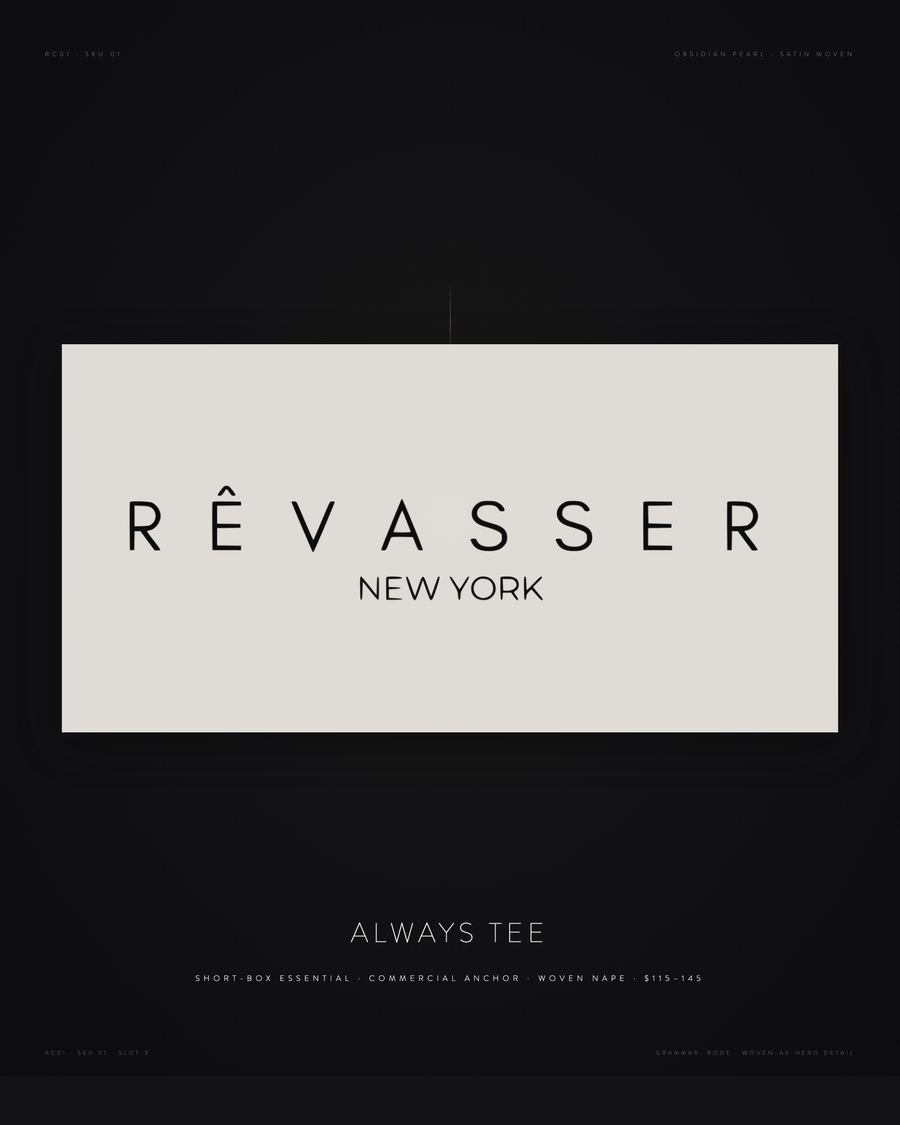
Custom spaced-serif wordmark, drawn circumflex

GENDER

Unisex

EVOKES

Editorial serif + industrial spec tag

POSITIONING

Elevated basics ($95–165), quiet-luxury adjacent

VISUAL BEHAVIOR

Horizontal emphasis — wants a wide, uncluttered canvas

PRINT METHOD

DTF, tonal plastisol, discharge, or tonal embroidery

PALETTE

Tonal-on-tonal — black/charcoal, off-white/cream, stone/black

REFERENCES

Margiela —

numerical tag as graphic; label-as-identity logic.

Lemaire —

quiet wordmark, tonal restraint, adult editorial.

Helmut Lang archival —

spaced serif + body-conscious rib; 90s codified.

Our Legacy —

product codes as copy system; spec language as voice.

NEXT STEPS

Strip and redraw.

Isolate wordmark only (no "NEW YORK", no spec, no price). Supply as vector at 8" and 12" widths.

Mock three silhouettes.

Fitted 2x1 rib tank (sternum, 8–10"); 240gsm boxy crew (across-body, 11–12"); longline fitted tee (hem wrap).

Render three colorways each.

Black/charcoal, off-white/cream, stone/black. Tonal only.

Run full tag as inner-neck label

on every sample — primary/secondary hierarchy proven.

Review, pick winner, DTF sample.

Lock as Look 01 → line sheet.

COMMENTARY — James · 2026-04
COMMENTARY — SLIDE 1 / NECK TAG · BRAND FOUNDATION

This is the brand in miniature. Every rule for the deck begins here.

THE CUSTOM LETTERFORM

Hairline spaced serif, stroke/cap ratio ~0.06. Custom drawn — not a commercial font. Closest reference register: YSL Cassandre (0.08), Dior Bodoni display, Jil Sander old mark.

Circumflex placement: optically floating 4-6% above cap-height, not mathematical center. This is correctly drawn — the diacritic reads as sitting above the E, not attached.

Tracking: +30 to +40 units at display sizes. Reads editorial-refined. Never compress below 0.

SLIDE 03
Slide 3

Asset 02 — Blender crystal tee render

ASSET

3D render — boxy tee w/ small crystal-cluster chest graphic

GENDER

Unisex (silhouette reads men-leaning as rendered)

EVOKES

Early-stage Blender mockup; not production-grade

POSITIONING

Iterative — working pipeline, graphic direction is viable

VISUAL BEHAVIOR

Motif underscaled, placement tentative — refine in next pass

PRINT METHOD

DTF on real garment — production path in parallel to Blender ideation

PALETTE

Charcoal base + violet crystal; keep palette, rebuild graphic

REFERENCES

Raf Simons A/W '03 —

crystalline / mineral graphics on dark ground.

Rick Owens DRKSHDW —

tonal dark-on-dark print, object-as-symbol placement.

Number (N)ine —

small emblem chest placement, distressed luxe.

Undercover —

graphic as narrative fragment, not decoration.

NEXT STEPS

Keep iterating in Blender as ideation.

Use for placement / palette / silhouette previews — not final renders. Proportions improve with each pass.

Work the DTF constraint.

Individuation has to come from graphic, placement, palette — not 3D realism. That's the lane.

Rebuild the crystal motif as flat vector.

Parallel track. Three scales: 4" small-hit, 8" chest hit, 14" oversize across-body.

Test placement in Blender.

Current low-right reads tentative. Preview centered 3" below collar, back-yoke, sleeve band.

DTF sample winning placement.

Feed real garment photo back into next Blender iteration — tighten the loop.

COMMENTARY — James · 2026-04
COMMENTARY — SLIDE 3 / BLENDER TEE · 3D IDEATION PATH

Good ideation tool. Not a finished asset. Don't confuse the two.

WHAT BLENDER IS GOOD FOR

3D ideation loops — test placement, scale, proportion, palette, lighting before committing to physical sample runs. Reduces sample cycles by 40-60% when used well.

Useful for: preview renders, e-commerce placeholder imagery, buyer pitch decks, tech-pack visual reference, spec sheets.

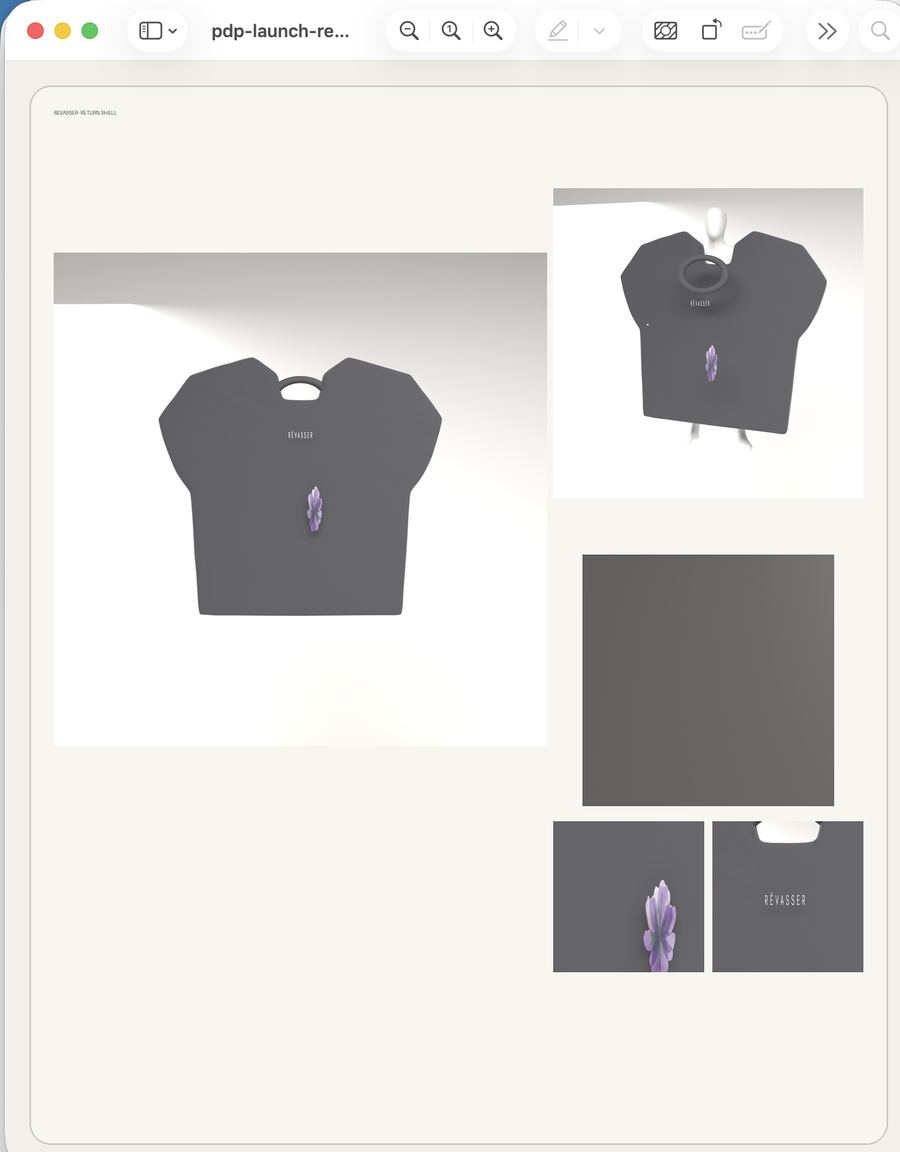
Current render shows charcoal 2x1 rib tank, small purple crystal/gem graphic at chest. Proportions are off — crystal reads sticker-scale (~25mm) on a body that should carry 60-80mm at minimum.

WHAT BLENDER ISN'T

A finished campaign image. Render fabric physics (2x1 rib drape, cotton weight, light absorption) will never match actual photography on a body.

A graphic decision tool. Colors in render vs colors in DTF at 240gsm cotton are ~15-25% off in chroma. Always sample print before signing off.

A substitute for wear-testing. Fit, comfort, drape, heat-retention all require real garment. Blender can suggest; only body can confirm.

WORKFLOW GOING FORWARD

Step 1: Blender render for chest-graphic placement sign-off. Run 3-5 scale variants (40mm / 60mm / 80mm / 100mm) side by side before committing.

Step 2: DTF test strike on actual fabric (single-unit cost $8-12, 72h turn). Validate color, density, hand-feel.

Step 3: Physical sample on body — shoot a real person in the actual garment. Casting decisions matter more than render decisions.

Never skip to retail/marketing directly from Blender render.

VERDICT

KEEP BLENDER — AS TOOL, NOT OUTPUT.

The pipeline itself has real value for ideation cycles and spec-pack development. Don't confuse render fidelity with finished asset. The current crystal tee is a scale-study, not a campaign image — annotate as such on the source slide.

SLIDE 05
Slide 5

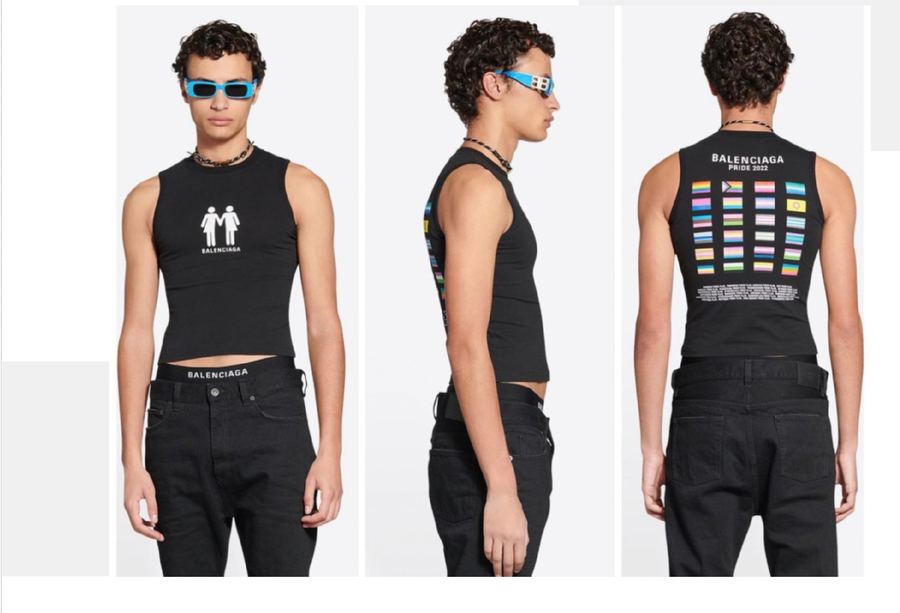
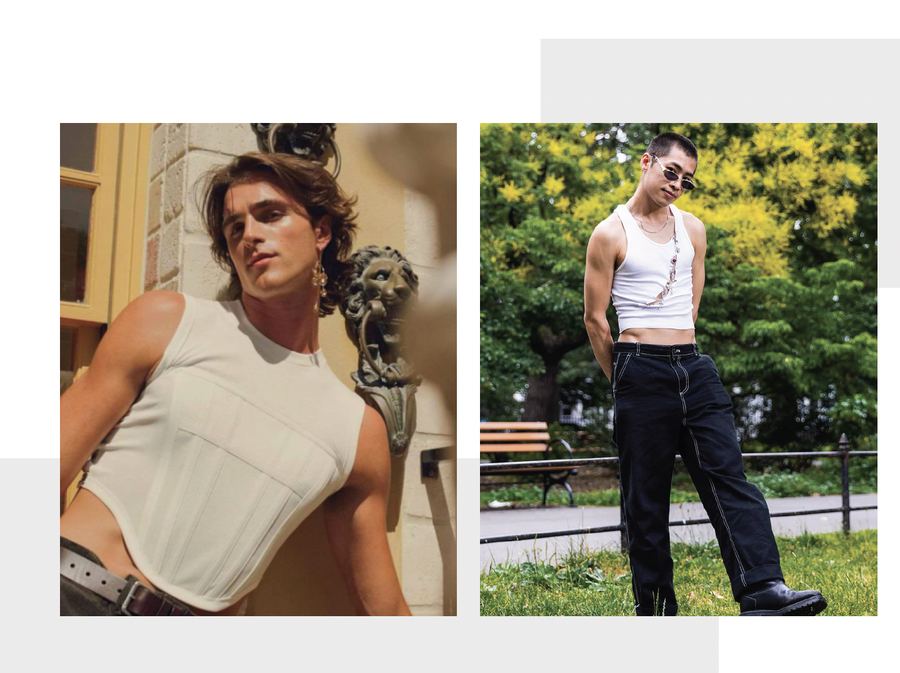
Asset 03 — Cropped menswear mood board

ASSET

Designer-validated cropped menswear references

GENDER

Men (transferable to unisex)

EVOKES

High-fashion cropped silhouettes, 2012–present

POSITIONING

Validated thesis — not niche, runway-proven

VISUAL BEHAVIOR

Shows skin/waistband tension; styling-led

PRINT METHOD

Construction, not print — cut-and-sew + hem detail

PALETTE

Navy, charcoal, yellow, pattern — match existing palette

REFERENCES

Thom Browne —

cropped suiting codified as menswear.

Louis Vuitton (Virgil) —

crop + pattern on luxury men's.

Raf Simons —

minimal yellow cropped knits.

Calvin Klein —

sportswear crop, body-conscious styling.

NEXT STEPS

Commit to cropped men's silhouette.

Thesis is designer-validated.

Spec two cropped TOPs.

Boxy crop tee (hem 2" above waist) + ribbed crop crew.

Spec one cropped LAYER.

Cropped hoodie or zip — the distinctive piece.

Merge with Asset 01.

Wordmark on cropped silhouette = signature look.

COMMENTARY — James · 2026-04
COMMENTARY — SLIDE 5 / CROPPED MENSWEAR MOOD BOARD · THESIS

The silhouette thesis is validated. Now commit to the SKU roadmap.

WHAT THE BOARD PROVES

Cropped menswear is a designer-validated thesis. Thom Browne codified it at scale; Raf Simons does shorter silhouettes in tailoring; Louis Vuitton (Virgil era) took it mainstream; Martine Rose plays with proportion consistently.

Not a trend — a silhouette vocabulary that's now 10+ years into menswear. Adult customer recognizes it as considered rather than novelty.

Rêvasser's commercial-anchor position lives here. $115-145 tees, $185-245 knits, $315-425 outerwear — all in cropped silhouette.

PROPORTION SPECIFICS

Tee / tank:

hem at iliac crest (~2cm above natural waist), body width +4cm beyond shoulder. Semi-crop.

Hoodie:

hem 3-5cm above natural waist, dropped shoulder +6cm, boxy cut. Reads architectural not athletic.

Long-sleeve:

hem at navel, fitted body (not cropped hoodie proportions). Cuff bound rib 6cm.

Trouser:

straight leg, rise at natural waist (not low-rise), ankle break, no cuff. Tailoring-register.

COMMIT TO A LAUNCH SKU SET

8-SKU MOS1 launch:

Core tank (SKU-01), core tee (SKU-02), long-sleeve (SKU-03), polo (SKU-04), hoodie (SKU-05), knit (SKU-06), trouser (SKU-07), sheer top (SKU-08).

Two colorways per SKU: bone + slate (FW), bone + oxblood (seasonal drop). Minimum viable launch = 16 SKU-colorways.

Don't launch with less than 8 SKUs.

Customer can't read a brand from 3 products. Don't launch with more than 12 — dilutes the editorial discipline.

VERDICT

THESIS LOCKED. SPEC THE SKUs.

Cropped menswear silhouette is the right lane and designer-validated. Stop researching — start specifying. 8-SKU launch set, two colorways each, Portuguese mill sourcing for premium tier. First tech pack within 4 weeks.

SLIDE 07
Slide 7

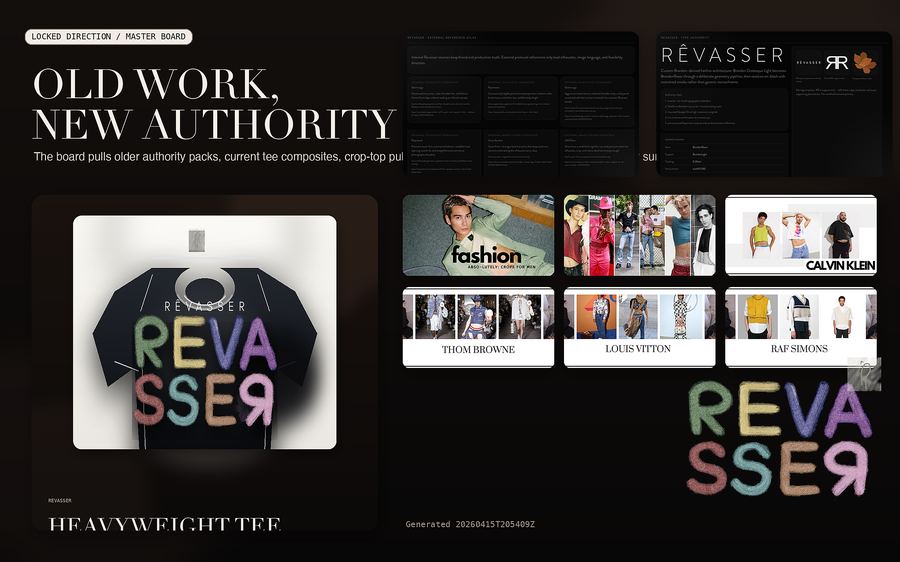
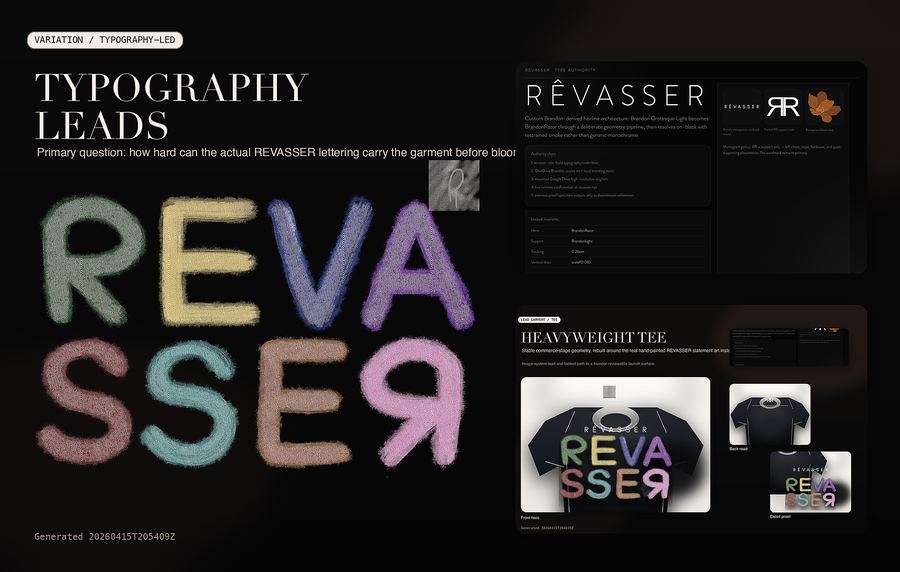
Asset 05 — Chenille/fiber wordmark (generative concept)

ASSET

Generative render — "REVASSER" in fiber/chenille letterforms, reversed R

GENDER

Unisex — craft tone reads widely

EVOKES

Chenille varsity, hand-tufting, intarsia knit, textile art

POSITIONING

Secondary/seasonal mark — craft register alongside primary wordmark

VISUAL BEHAVIOR

Texture IS the idea; reversed R is deliberate art direction

PRINT METHOD

Chenille patch, jacquard intarsia knit, tufted applique, chainstitch embroidery

PALETTE

Pastel multicolor on black — pink, butter, sage, mint, dusty rose, cocoa

REFERENCES

Bode —

hand-embroidered letterforms, Americana craft on luxury menswear.

ERL —

chenille patches and varsity lettering reworked playfully.

KidSuper —

felted / tufted applique, childlike graphics on luxury knits.

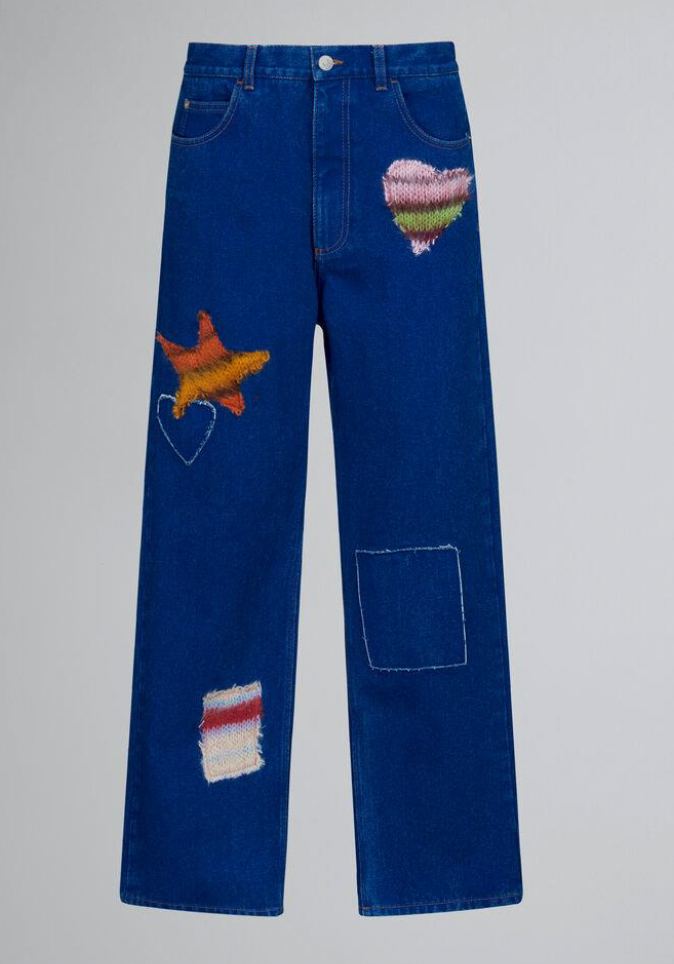
Marni —

multicolor intarsia knit, pastel-on-dark palette logic.

NEXT STEPS

Redraw letters as clean vector.

Keep the reversed R. Crisper letterforms — texture comes from material, not the rendering.

Test two production routes.

(a) Chenille/felt patch applique on heavyweight crew. (b) Multicolor intarsia knit sweater.

Position as seasonal/craft mark.

Sits alongside editorial serif (primary) and floral (secondary). Third register: tactile/playful.

Explore soft-goods extension.

Terry robe / towel / beanie — tactile mark lands better on fleece and knit than on jersey tees.

Sample one patch on one garment.

Chenille back-yoke on a heavyweight crew. Prove the tactile mark reads in physical form before scaling.

COMMENTARY — James · 2026-04

COMMENTARY — SLIDE 7 / CHENILLE WORDMARK · GENERATIVE CONCEPT

Texture is the lesson. Generative output is not the execution.

WHAT THIS IS

Generative output — RÊVASSER wordmark rendered as chenille-texture fiber fill. Each letter has a fuzzy yarn-like surface treatment, varying pigments per letter.

Lineage: Bode's hand-embroidered letterforms, ERL's chenille patches, collegiate varsity applique. Americana-craft register.

Execution inconsistency: letter weights uneven, reversed R handled awkwardly, texture density varies unpredictably across characters.

TEXTURE AS LESSON

The real signal here is tactile depth. Chenille, bouclé, terry-loop, raised-chain embroidery all carry physical texture that flat print can't match. That's the transferable idea.

Real chenille patch: woven or tufted, sewn on, no computer render can substitute. Costs $8-18 per patch at 200 MOQ through varsity-supplier trade.

For Rêvasser: chenille patch with skeletal R (not the wordmark — too complex for chenille execution).

IF DEPLOYED — SPEC + SUPPLIERS

Chenille patch (skeletal R):

80mm tall, bone chenille on bone felt backing (tone-on-tone), wax-thread edge. Stahls' Transfer Express or Chenille Kraft (US MOQ 50) or Yangzhou Patchwork Co (China MOQ 300).

Terry-loop embroidery:

raised loop stitch (like terry towel texture) as alternative to chenille. $4-8/piece, same suppliers as satin embroidery.

Deploy on:

varsity jacket back (150mm R), hoodie chest (60mm R), tote face (100mm R). Never on fine-gauge knit or sheer — needs substantial substrate.

VERDICT

CONCEPT → PRODUCTION JUMP.

The chenille render is a concept pitch — texture is the right idea. Take it off the render and onto a real patch. Skeletal R at 80mm, tone-on-tone, sewn onto a varsity jacket or hoodie chest. Cost: $12-18/piece, MOQ 50-200. This is a seasonal-accent product, not a core SKU — one per drop maximum.

SLIDE 09
Slide 9

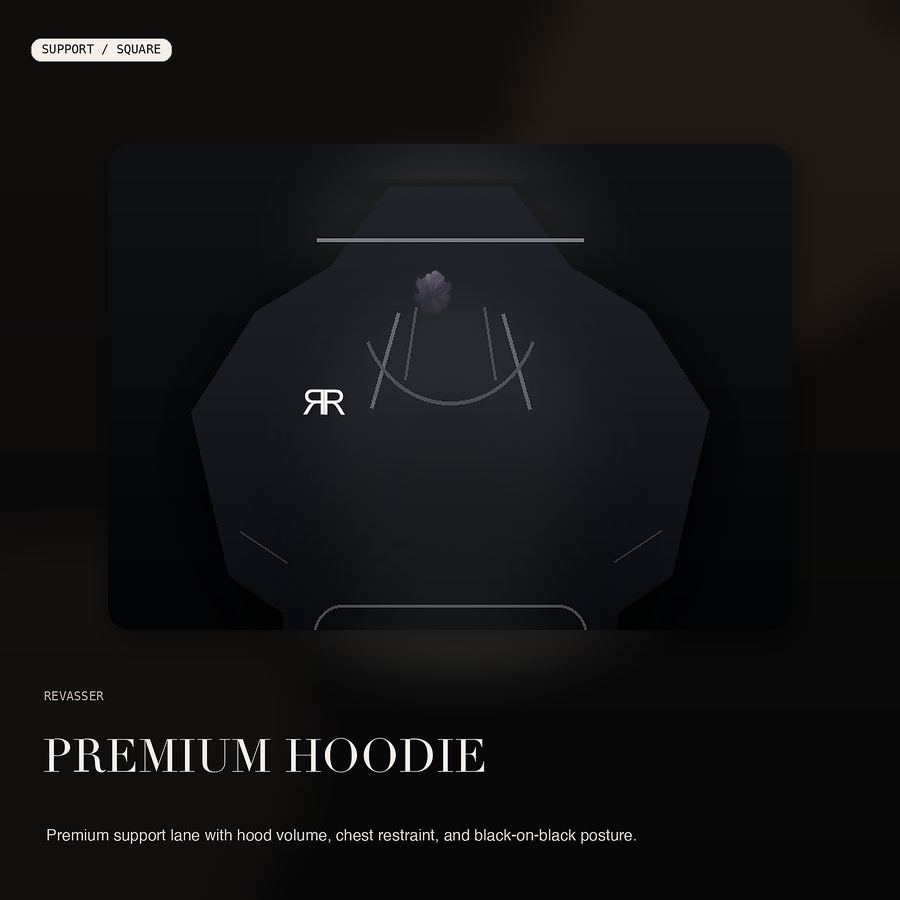
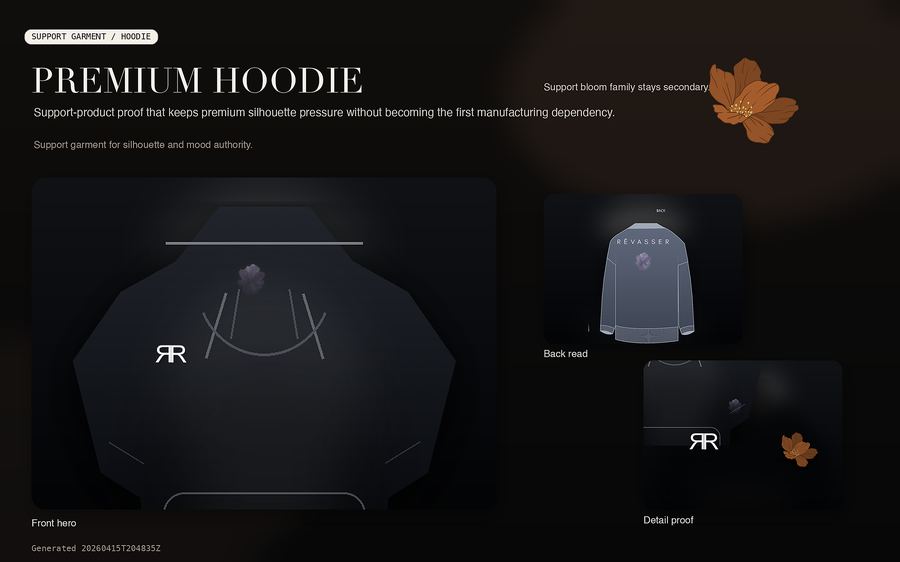
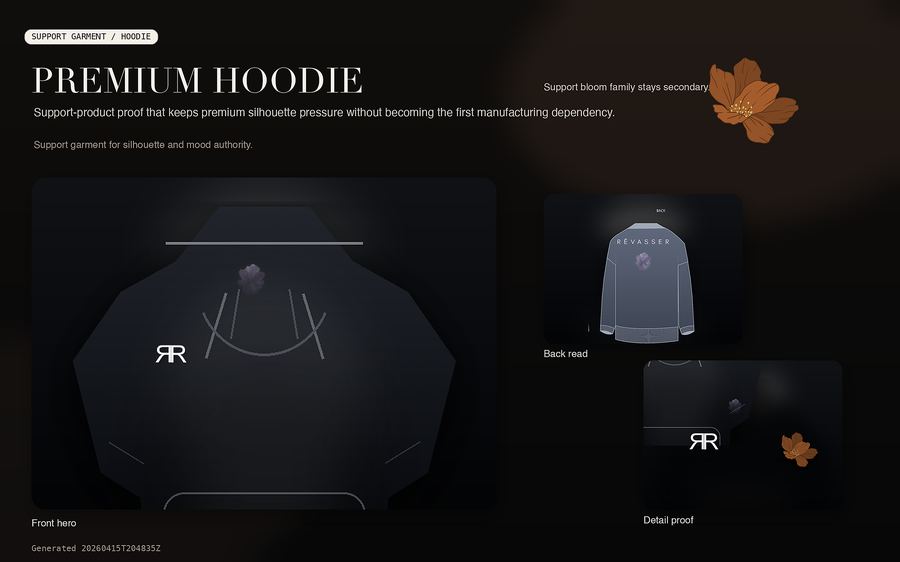
Asset 04 — Premium hoodie (RR monogram + harness)

ASSET

Black hoodie w/ interlocking RR monogram + chest harness

GENDER

Unisex (structurally men-leaning)

EVOKES

Technical luxe / architectural menswear

POSITIONING

Premium support lane ($165–245 band)

VISUAL BEHAVIOR

Black-on-black tonal; harness adds sculptural line

PRINT METHOD

Tonal embroidery or puff print; woven cord for harness

PALETTE

Black-on-black primary; violet floral as collar accent

REFERENCES

Alyx —

rollercoaster buckle / chest harness as technical jewelry.

Heliot Emil —

Scandinavian techwear, tonal blackwear, architectural hoodie.

Fendi / Gucci monogram logic —

interlocking letters as heritage mark.

Rick Owens —

black-on-black tonality; sculptural hoodie silhouette.

NEXT STEPS

Refine RR monogram tonally.

Test three executions: tonal puff print, matte embroidery, silicone rubber.

Simplify the harness.

Single tonal woven cord across chest, no buckles. Easier to produce than full Alyx-style hardware.

Lock black-on-black.

Heavyweight 450gsm cotton body, matte monogram, matte cord. No contrast.

Add second colorway.

Bone/off-white tonal for contrast with the hoodie range — proves the system reads in light too.

Sample one hoodie.

Black-on-black first; treat as hero SKU.

COMMENTARY — James · 2026-04
COMMENTARY — SLIDE 9 / PREMIUM HOODIE · HERO PRODUCT

The hero product direction. Construction decisions drive everything downstream.

GARMENT CONSTRUCTION

Premium heavyweight hoodie: ~400-480gsm loopback or brushed-back cotton fleece, boxy cropped silhouette, dropped shoulder, set-in sleeve, ribbed cuff + hem, drawcord hood.

Visible on image: RR monogram chest center, chest harness detail (slide 9 original), small floral accent near collar. Heavy composition — too many elements competing.

Silhouette is right. Decoration load is too high.

DECORATION HIERARCHY

One mark per surface, one surface per garment. Current hoodie has three: chest RR, harness, floral collar accent. Remove two of three.

Keep:

skeletal R at chest center, 80-100mm tall, ton-sur-ton satin embroidery (bone thread on bone fleece, or slate on slate).

Remove:

chest harness (costume-register), floral collar accent (redundant with hem-tag or interior label placement).

Optional back yoke:

single cosmos bloom at 40mm, small seasonal-colorway indicator. Not both chest and back.

PRODUCTION ECONOMICS

Premium tier (Portugal cut-and-sew):

$45-65 blank + $5 embroidery + $8 labels/tags + $4 packaging = $62-82 landed at 200 MOQ. Retail $235-315.

MVP tier (Alibaba blank + NYC embroidery):

$18 blank + $5 embroidery + $8 labels + $3 packaging = ~$34 landed at 100 MOQ. Retail $135-175.

Suppliers:

Polopique (Portugal, all-in at MOQ 200), SS Activewear (US blanks + local decorator), Bella+Canvas 3739 heavyweight hoodie blank.

Recommend:

Portugal for hero-tier hoodie at $275 price point, Alibaba for MVP test batch at $145.

VERDICT
SILHOUETTE YES. DECORATION STRIP.

Hoodie silhouette, weight, and proportion are the right direction. Kill the harness and floral collar — the skeletal R at chest in tonal embroidery is the entire brand move. Premium tier Portugal production at $275, MVP tier at $145 for early drops.

SLIDE 11
Slide 11

Detail 04a — RR monogram + bloom, close study

WHAT THIS SHOWS

Close-up of RR monogram (chrome/silver) and a small terracotta cosmos bloom on slate-black.

WHAT'S WORKING

Monogram geometry is clean; bloom scale reads as a whisper, not a statement — good secondary logic.

WHAT'S OFF

Monogram too contrasty — chrome sheen overpowers the tonal language set by the neck tag.

SCALE CHECK

Bloom sits ~6" right of monogram with no tension. Needs proximity or deliberate distance.

COLOR CHECK

Terracotta reads warm against cool slate — fights the violet bloom elsewhere. Pick one family.

REFERENCES

Lemaire —

back-yoke wordmark placement, tonal restraint.

Our Legacy —

signature back-graphic + construction detail.

Jil Sander —

discipline + small botanical, restrained counterpoint.

Toteme —

tonal wordmark as signature, quiet confidence.

WHAT TO PUSH NEXT

Kill the chrome.

Redraw monogram as matte bone (#E8E3D8) on slate — tonal, two value steps only.

Lock one bloom.

Violet cosmos (neck-tag adjacent) or terracotta (warmer, earthier) — not both in the brand system.

Fix the composition.

Place bloom touching monogram OR ≥10" away at deliberate distance. Current midpoint reads accidental.

Re-shoot close-up in DTF sample.

Render is informative; a real DTF sample photograph will decide the monogram weight question.

COMMENTARY — James · 2026-04

COMMENTARY — SLIDE 11 / RR DETAIL · PRODUCTION FOLLOW-UP

The detail brief is locked. Here is the production path from redraw to DTF sample.

WHAT DETAIL 04a LOCKED

From the previous detail brief: redraw RR at stroke/cap 0.09-0.11, remove horizontal crossbar, kill splayed feet, one bloom type (violet cosmos) in a tonal-system palette.

That brief was structural — what to change. This slide is the production path — how to take that redraw into actual DTF sample.

Timeline: redraw (4-6hr type designer time) → vector prep → DTF strike → sample on body.

REDRAW BRIEF

Deliverable:

vector master file (AI or SVG), 3 weights (hairline 0.06, regular 0.075, medium 0.09), single-color drawing + color-claim variant.

Budget:

$900-1500 for competent type designer. Upwork tier: $300-600 but variable quality. Recommend: small independent foundry (Commercial Type, Grilli Type, or local freelancer).

Timeline:

4-6 hours design work, 48-72hr turnaround. 1 revision round included.

DTF SAMPLE PATH

Step 1:

vector prep — trap +0.25pt on all hairlines, set spot colors, export 300dpi PNG + layered PDF.

Step 2:

DTF strike on target fabric at 3 sizes (40mm / 60mm / 80mm). Print on actual cotton swatch in intended color. $15-25 single-strike cost, 72hr turn.

Step 3:

physical sample on hoodie and tank blank. Shoot against wordmark at same scale to check type-system coherence.

Suppliers:

BelRays Printing (NYC), Transfer Superstars, STAHLS' Transfer Express. All 24-72hr turn.

VERDICT

2-WEEK PATH TO DTF SAMPLE.

Week 1: commission type designer for RR redraw ($900-1500). Week 2: DTF strikes at 3 sizes, physical sample on hoodie + tank. By end of week 2 you have a body-shot reference of the redrawn mark. Total: ~$1,600 to go from rough concept to production-ready asset.

SLIDE 13
Slide 13

Detail 04b — Back wordmark + bloom, placement study

WHAT THIS SHOWS

Back view of hoodie — RÊVASSER wordmark centered across upper back + violet cosmos bloom below right shoulder blade.

WHAT'S WORKING

Wordmark sits well above the shoulder-blade line, reads editorial not uniform. Back is the correct surface for a wordmark at this weight.

WHAT'S OFF

Wordmark letterspacing too tight at hoodie scale — circumflex disappears from reading distance. Bloom feels adrift from wordmark.

SCALE CHECK

Wordmark ~11" wide on a ~22" back = 50% width. Can push to 55–60% with more open tracking for better read.

COMPOSITION

Bloom floats in visual no-man's land. Anchor it: tuck under wordmark's right terminus, or drop to hem-right.

REFERENCES

Lemaire —

back-yoke wordmark placement, tonal restraint.

Our Legacy —

signature back-graphic + construction detail.

Jil Sander —

discipline + small botanical, restrained counterpoint.

Toteme —

tonal wordmark as signature, quiet confidence.

WHAT TO PUSH NEXT

Open the tracking.

Push letterspacing +200 units so the circumflex survives at 10-foot read. Keep wordmark weight thin.

Anchor the bloom.

Move violet bloom directly below wordmark's R-terminus OR to hem-right above side seam. Kill the float.

Test A/B placement.

Render two back comps — bloom-under-R vs bloom-hem-right — decide on the photography test, not the screen.

Lock wordmark as back-only.

No chest logo. Back is the signature; front stays clean or carries monogram only. Hierarchy = discipline.

SLIDE 14
Slide 14

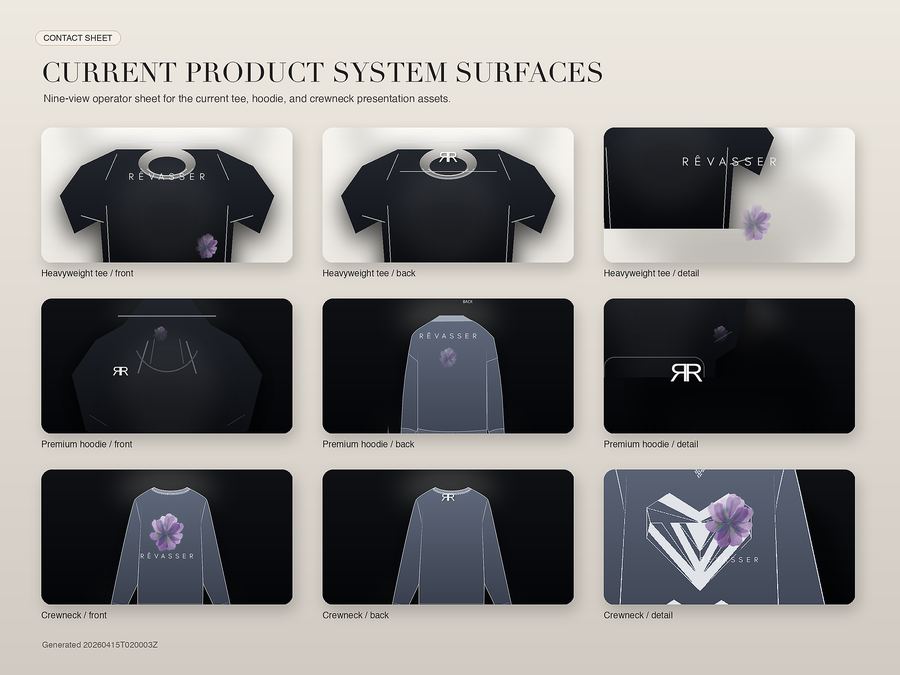
System 01 — AI/Blender rendering pipeline status

STATE

Pipeline is producing usable 3/4, back, and detail views at consistent fidelity. Monogram + bloom placement renders reliably. Output quality is ideation-grade, not photography-grade.

DECISION

Keep pushing.

The pipeline is earning its keep — it's a rapid visualization tool for placement, proportion, and palette tests before committing to sample production.

Do NOT use outputs as final campaign imagery or customer-facing assets.

NEXT

Use pipeline to pre-vis 2-3 monogram alternatives from Slide 9 on hoodie/tee before sample.

Build one master template per silhouette (tee, hoodie, crew) so iteration is 2-minute turns.

Renders feed DTF sample brief; real garment photography replaces renders for lookbook/ecomm.

SLIDE 15
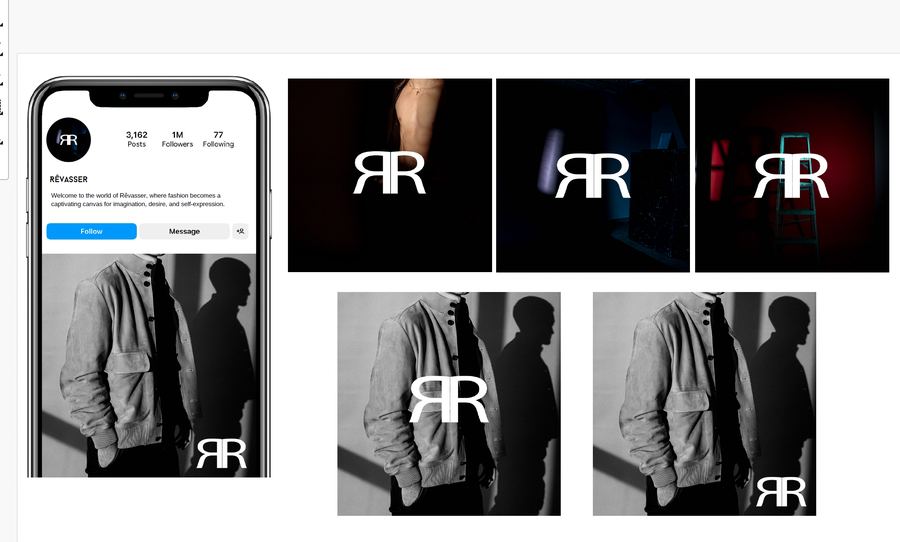
Slide 15

Art Direction 01 — Chest monogram, placement + form study

A — CHEST, LARGE B — HEM, SMALL

READ — PHOTOGRAPHY

Side-light + hard shadow is the strongest element — lock as house lighting signature.

Posture passive: hand-in-pocket, rounded shoulders. Photoshop stance wider, drop shoulder.

Crop tighter — remove headroom; let shadow do compositional work.

A/B CALL — PLACEMENT

B wins.

Hem-right reads as signature; chest-large reads as uniform.

Scale down another 20% from B — mark should whisper.

Rule: chest clean, back wordmark, hem mark. Hierarchy = discipline.

MONOGRAM IDEATION — ALTERNATIVES TO RR

— single initial + circumflex. Cleanest lift from neck tag.

^ alone

— diacritic only. Tiny, confident, unbranded.

RV ligature

— fused first+last consonant. Loewe/Celine logic.

RVS·NY

— spec-code mark. Margiela/Visvim numerical logic.

SLIDE 16
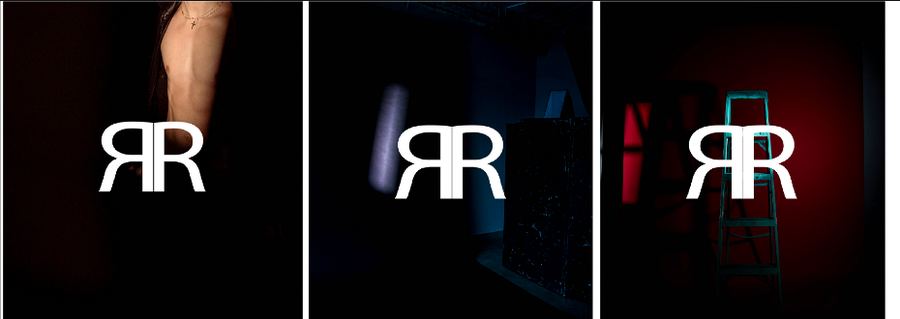
Slide 16

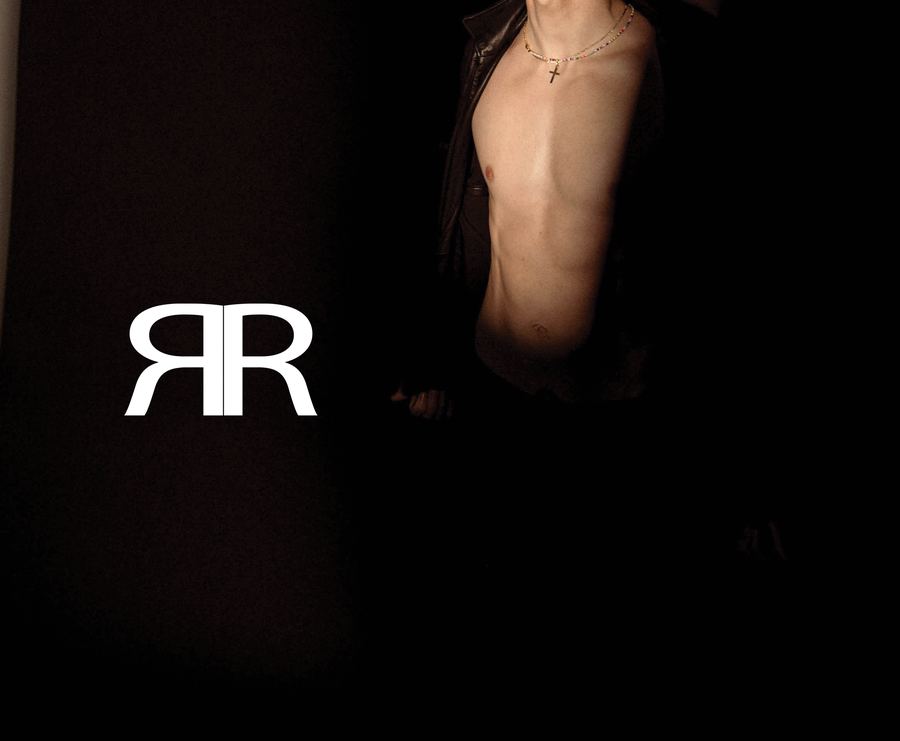
Panel A — Torso + RR monogram (keep, rework in post)

VERDICT
KEEP.

Convert B&W, remove pendant, recrop monogram.

THE REAL READ

Body is fine — lean build, visible collarbone, natural male proportion. Not a casting problem.

Monogram sits at lower sternum — awkward mid-zone, not chest-authoritative or waist-graphic. Floats.

Cross pendant pulls focus to model-as-character. Warm tungsten cast on skin fights the cool brand register.

PHOTOSHOP DIRECTION

B&W via Channel Mixer

(R40/G40/B20). Blacks -25, whites +15, clarity +10. Cool +5 in highlights.

Remove cross pendant.

Clone-stamp collarbone clean. Frequency separation at 50% max — keep pore texture.

Recrop monogram to chest level

(heart-pocket zone) OR right collarbone asymmetric (brooch placement).

Test silver foil overlay

on monogram — ties to slide 15 material-language thread.

IF RE-SHOOTING INSTEAD

Single hard key light camera-left 45° high, no fill. Matte black muslin backdrop (no painted-wall sheen). Lindbergh-register high-contrast B&W — deep blacks, creamy highlights, grain preserved.

SLIDE 17
No visual · text-only

Panel B — Empty studio (kill as campaign, repurpose as asset)

VERDICT

KILL as campaign.

REPURPOSE as web asset.

WHY IT FAILS WITH THE MONOGRAM

No subject, no tension. Foam cylinder + black crate read as set dressing mid-build, not composition.

Monogram floats center-frame over emptiness — reads "logo waiting for product," not an editorial statement.

But strip the RR and the frame becomes raw material — dimensional studio, moody low-key light, found-object sculpture.

WEBSITE + DIGITAL REPURPOSE (STRIP THE RR FIRST)

About / story page hero

— full-bleed background, wordmark serif overlay bottom-left, headline sits in the foam-cylinder negative space.

Lookbook interstitial

— mood-breather every 3–4 garment pages. No product, just space and low-key light.

404 / loading / between-states

— empty studio = empty page. Conceptually coherent instead of stock "oops" graphics.

IG story / reel background

— vertical 9:16 crop, type animates in foreground, shadow architecture stays stable behind it.

Newsletter + email header

— horizontal crop with small wordmark anchor, subject line typesets over the foam highlight.

PRODUCTION MOVE — BUILD A SIGNATURE SET

Shoot 8–12 companion frames from this exact setup — same room, different props (stool, bolt of fabric, folded stack, single shoe, empty hanger).

Same camera position, same lighting. Lock tungsten 3200K key light, black flag camera-right, 2:1 contrast ratio. Shoot on a static 50mm.

Over 4–6 drops this becomes a recurring spatial signature — recognizable as RÊVASSER without a logo ever appearing.

SLIDE 18
No visual · text-only

Panel C — Red room + teal ladder (hero, build a world)

VERDICT
HERO.

Build a visual world around this frame.

WHY IT WORKS

Tight color logic: oxblood walls + teal ladder = complementary split, chromatic tension without chaos. Real palette discipline.

Ladder as vertical spine — composition reads as diagram, not snapshot. Monogram centered over the treads has axis, not float.

Theatrical, not costume. Red room reads as deliberate set-piece (gallery, studio, installation) — not styled apartment.

Monogram scale is right: dominant but not overscaled — sits at ~40% frame height, aligned with ladder apex.

APPLICATIONS — WITH AND WITHOUT THE MONOGRAM

Campaign hero (as-is)

— leads the seasonal campaign, anchors all OOH/print/digital. This is the image that sells the world.

Landing page hero (no RR)

— full-bleed, wordmark top-left, season name top-right, ladder as eye-leading line into the navigation.

Category page headers (no RR, re-colored)

— re-shoot same set in different wall colors per category (outerwear/tops/knits/bottoms).

IG grid anchor

— every 9th tile is a saturated color frame. This becomes the "color tile" recurring motif across drops.

Shipping box insert card

— 4×6" postcard with this frame, thank-you copy on reverse. Unboxing gets an image to keep.

Runway / presentation backdrop

— if/when you do a presentation, this is the lighting + color setup. Ladder goes live.

THE LADDER AS BRAND OBJECT

Buy the exact ladder — teal tubular A-frame, ~5ft. Paint a corner of the studio this red (Benjamin Moore Red #2000-10 or Sherwin-Williams Rave Red SW 6608). Photograph product against this wall every drop. Set consistency over 4–6 seasons is how brand equity accrues without logo dependency.

SLIDE 19
Slide 19

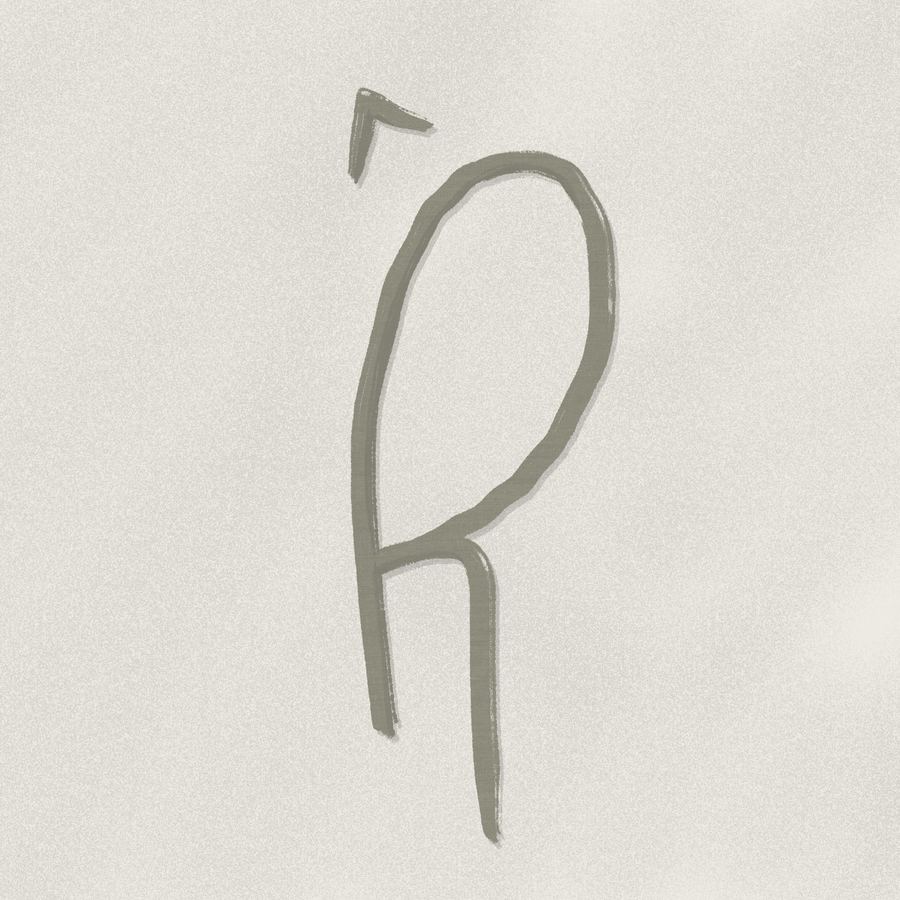
Ideation 01 — Hand-drawn R̂ monogram, two registers

A — OLIVE ON CREAM
B — WHITE ON BLACK
KEEP BOTH

Two registers of the same mark.

A = editorial

hangtags, labels, paper.

B = campaign

garments, IG, print.

EVOKES

Yohji Yamamoto hand-calligraphed tags. Margiela "Replica" stamped labels. Sofie D'Hoore painted interior marks. The artist's hand against the brand's typographic discipline.

APPLICABILITY

A:

paper hangtags, interior labels, care tags, shipping stamps, lookbook end-pages.

B:

garment back-prints, IG splash frames, campaign wheatpaste, screenprint on tee muslins.

TECHNICAL

Vector trace keeping brush texture — high-fidelity Image Trace, preserve dry-brush gaps + circumflex asymmetry.

Lock palette: olive #6B6654 on cream #F0EBDF / white on #1A1A1A.

Print methods: discharge (garments), foil stamp (paper), matte embroidery thread — never glossy.

SLIDE 20
Slide 20

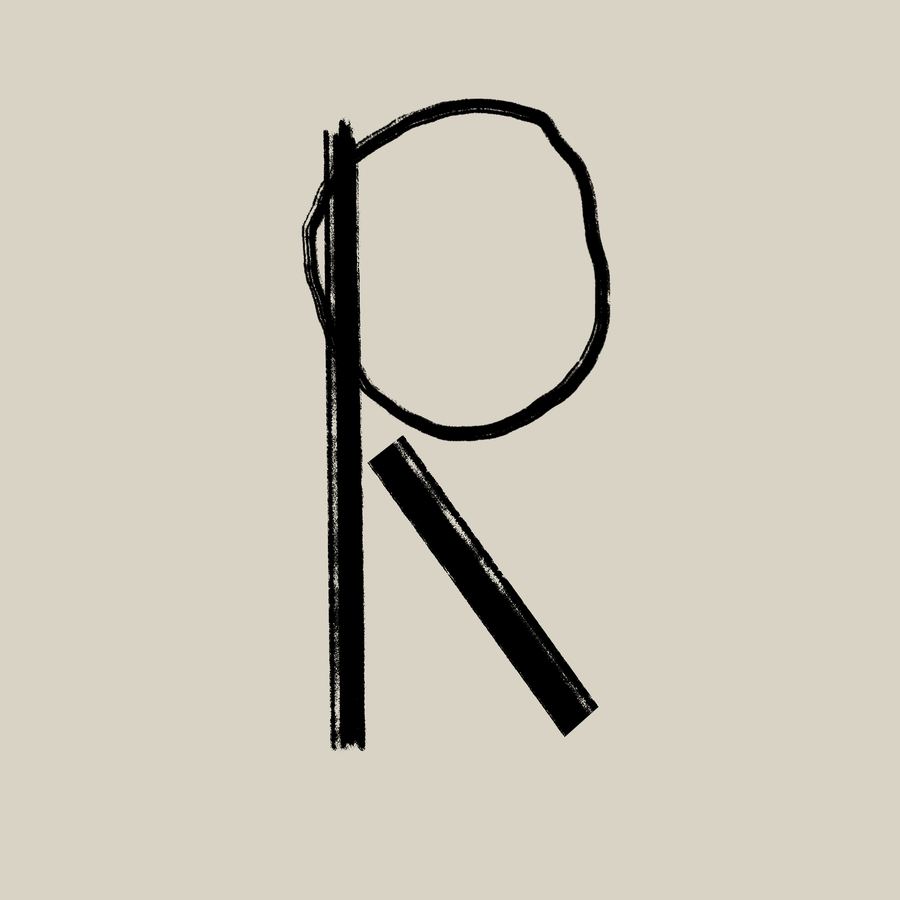
Ideation 02 — R as three-stroke composition

A — ASSEMBLED
B — DECONSTRUCTED
A WINS

Confident assembly reads as R. Integrity.

B weak.

Scratchy bowl reads as indecision.

Use as seasonal artwork, not logo.

EVOKES

Karel Martens constructivism. Peter Saville / Factory Records. Raf Simons A/W '98 broken type. Arte povera typography — rough tools, formal work.

APPLICABILITY — AS ARTWORK, NOT LOGO

Seasonal lookbook cover, large-scale on uncoated cream cardstock.

Jacquard back-panel, tone-on-tone ecru thread on cream knit.

Screenprinted canvas patch on utility workshirt pocket.

TECHNICAL

Redraw B's bowl as single confident ellipse offset from spine — kill scratchy multi-line.

Develop as 4-piece series: assembled → drifting → separated → reassembled.

Oat ground #D9D2B8 is correct — do not move to white.

SLIDE 21
Slide 21

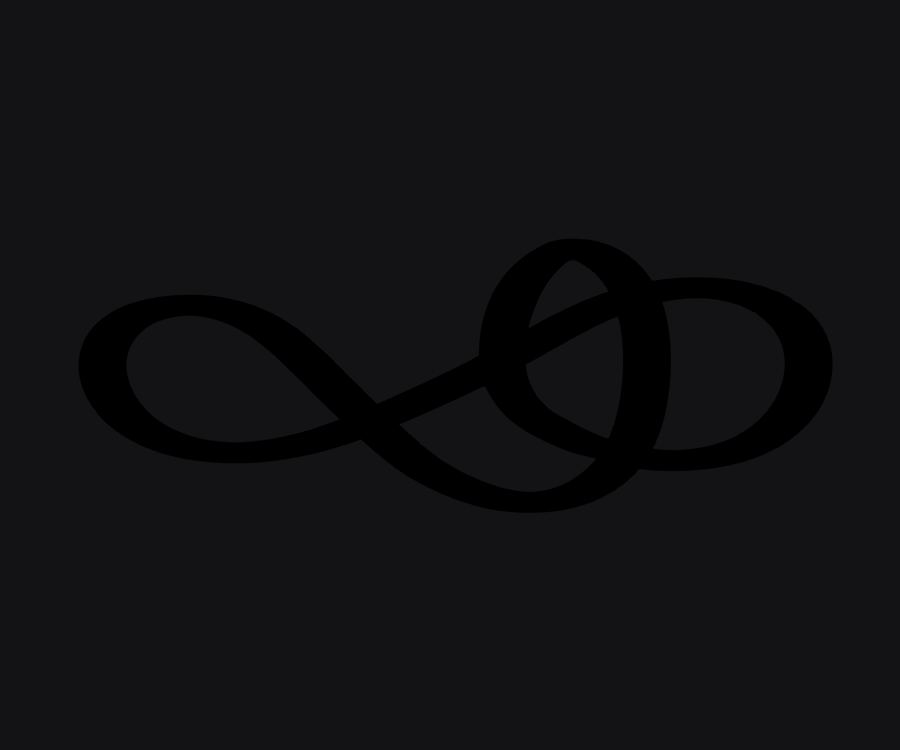
Ideation 03 — Geometric line studies

A — CURVILINEAR LOOPS
B — STACKED TRIANGLES
A — KILL

Reads treble clef. Brand-confused.

B — PUSH

As textile pattern, not logo.

EVOKES

A:

treble clef / Chanel interlock. Wrong register for the brand.

B:

Josef Albers Structural Constellations. Issey Miyake pleated geometry. Naum Gabo constructivism.

APPLICABILITY — B ONLY

Jacquard repeat tile at ~2" module, tone-on-tone knits (Junya / Sacai).

Single-hit back-print, tonal silk shirt or long sleeve (Our Legacy / Kiko Kostadinov).

Debossed on leather small goods (wallet, bag flap).

TECHNICAL

Redraw B as single continuous stroke — currently reads as three overlapping shapes.

Vector with variable line weight — thicker at vertices, thinner on long edges.

Pattern pass: build 4-way tiling lockup before committing to fabric sample.

SLIDE 22
Slide 22

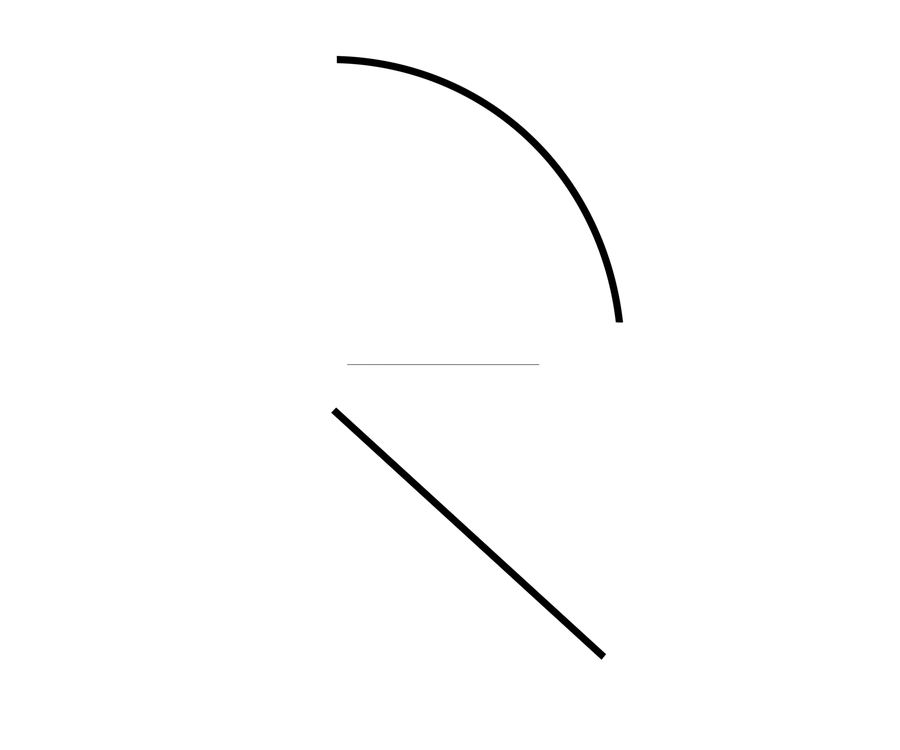
Ideation 04 — Skeletal R, three-stroke architecture

A — THIN / FAINT BAR
B — SOLID BAR
B WINS

Solid bar reads as choice. A's faint bar reads as mistake.

Most logo-viable of the studies.

Hardware register — small, precise.

EVOKES

Wolfgang Weingart deconstructed type. Ed Fella raw letter studies. Experimental Jetset minimalism. Carsten Nicolai / Raster-Noton. Negative space completes the letter — confident graphic design.

APPLICABILITY — HARDWARE REGISTER

Embossed metal pin, laser-etched zipper pull, engraved button.

Debossed leather patch at zipper base or sleeve cuff.

Small single-color print on jacket pocket or sleeve. Not chest hero.

TECHNICAL

Vector pure. Match all three stroke weights (curve = bar = diagonal).

Lock negative-space proportions — gaps between strokes must stay precise at every scale.

Min 20mm / max ~60mm. Scales beyond collapse into noise.

SLIDE 23
Slide 23

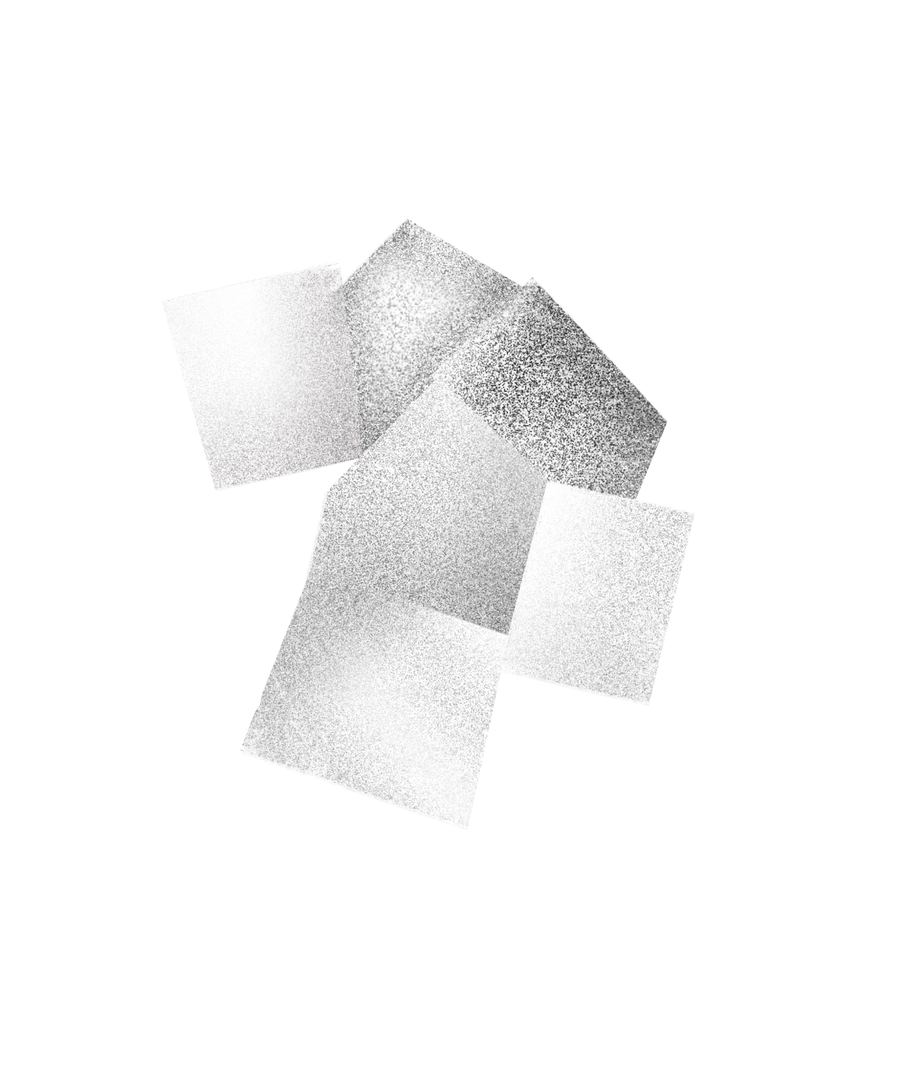
Ideation 05 — Silver foil paper composition

KEEP — PUSH AS PRINT, NOT LOGO

No wordmark or monogram viability — composition is abstract. But the

material register

(metallic, grainy, tactile, paper-cut irregularity) is rare in menswear graphics. That's the hook — not the composition, the surface.

EVOKES

Matisse paper cutouts ("Jazz", "The Snail"). Anni Albers modular grids. Raf Simons × Sterling Ruby FW '17. Helmut Lang's late-90s silver foil. Adjacent: Issey Miyake A-POC, Craig Green painterly graphics.

APPLICABILITY

All-over print on silk shirt or poplin overshirt — abstract terrazzo across the body (Raf / Prada register).

Single large back-panel print on dress shirt or light jacket — scale reveals the grain.

Debossed metal plates on bag hardware — literal metal, not printed metal. High-concept move.

TECHNICAL

Do NOT vectorize — grain is the point. Preserve as high-res TIFF.

Silver foil transfer or metallic discharge print. Never digital — digital flattens the metal.

Mono palette only. Silver is the hero — no second color.

COMMENTARY — James · 2026-04

COMMENTARY — SLIDE 18 / COSMOS BLOOM PRINT FAMILY · PRACTICAL + IP LENS

A real print family. Resize down, land on the hoodie, file as IP specimen.

CRAFT READ

Gouache/watercolor register, visible brushwork, hand-mixed pigment gradations. Not vector, not AI — the touch is human and that's the asset. Same 6-petal cosmos geometry across all three, so this reads as a family, not three competing options.

Petal layering is where the quality lives — overlap transparency suggests translucent wash, center stamen in contrasting pigment reads as deliberate botanical accuracy rather than decorative symbol.

Lineage:

closer to a botanical plate (Redouté, Audubon) than to streetwear floral (Needles, Online Ceramics). That's the considered register you've been building.

APPLICABILITY

Works on:

hoodie chest accent (small scale, 60–90mm), hem tag applique, lookbook chapter breaks, neck label inner print, hangtag reverse, IG drop tile, shipping card art.

Also works as:

a seasonal color-coded signifier. Lavender = SS drop. Oxblood = FW drop. Chartreuse = capsule/limited. The three shades become a calendar system.

Don't use as:

all-over print (dilutes the craft), chest hero at full scale (overwhelms the quiet brand register), or paired with RÊVER wordmark on the same side (fights for focus).

At small scale:

resize to 40–60mm on the body and it becomes almost an embroidered patch in feel — quieter, more finished.

PRODUCTION REALITY — DTF WINDOW

DTF-ready with adjustments: (1) flatten at 300dpi output, (2) check pigment bleed at petal overlaps — soften to 88% opacity if strikethrough appears, (3) confirm white underbase prints at matte not gloss.

Best method:

DTF matte film, 160°C cure 15s. Alt: water-based discharge on 240gsm cotton (closer to the gouache feel but needs test strike).

For IP specimen:

USPTO Class 25 specimen needs a printed garment with the mark affixed and offered for sale. DTF on blank hoodie + Shopify listing (one SKU, any quantity) clears the "use in commerce" bar. This print could be the specimen vehicle.

VERDICT

KEEP + ship.

This is the most IP-ready asset in the deck after the wordmark. Hoodie chest accent at 60mm in oxblood, paired with RÊVASSER interior label — that's a specimen that satisfies USPTO "use in commerce" and anchors the print family as part of the registered mark's visual lexicon.

SLIDE 27
No visual · text-only

COMMENTARY — SLIDE 19 / HAND-DRAWN R + COLOR LAYER EXPERIMENT

Left hand is gold. Right hand is a tech demo. Don't confuse them.

LEFT — R WITH BOTANICAL ENTWINEMENT

Bespoke drawn letterform. Crimson stem with vines and leaves hand-rendered, wrapped at three anchor points (baseline curl, mid-stem spiral, apex tendril). Not a Photoshop composite — the irregularity of the vine line-weight reads as single-hand execution.

Letterform is a drawn Didone/modern serif — high stroke contrast, hairline serifs, tall x-height. Risky on its own (thin parts vanish in reproduction), but the vine wraps compensate by adding mid-range tonal weight.

Color logic: single spot red (~Pantone 7427C oxblood) + single green (~Pantone 555C forest). Two-spot palette keeps DTF cost down and gives a cleaner trademark drawing.

Lineage:

William Morris drop-caps, Arts & Crafts initials, early Penguin Classics title decorations, hand-embroidered Bode monograms. Editorial, not streetwear.

RIGHT — BLURRED LAYERED R

Multi-color ghosted stack (Photoshop motion blur or After Effects layer echo). The color stripe is sampled off a palette grid, not composed — colors read as swatch samples rather than chosen pigments.

The underlying letterform is the same Didone R — sound structure. Problem is the treatment: Gaussian/motion blur softens edges that DTF print can't reproduce (requires hard raster boundaries at 300dpi).

Reads as screensaver or title card — decorative motion, not an editorial statement. The multi-color layering attempts texture where the left asset earns it through actual hand-drawn material quality.

Don't print this.

Fake blur + fake layer offsets = cheap when flattened. Works only where motion is native (video, GIF, SVG animation).

PRODUCTION + IP PATH

Left (R+botanical) — production:

scan at 600dpi, trap hairlines +0.25pt for DTF safety, preserve red + green as spot colors. Hoodie chest 120–140mm, or back-yoke 80mm. Discharge screenprint on 240gsm cotton is the premium option; DTF matte is the fast path.

IP category:

design mark (stylized) with color claim. Counsel can file the drawing in black-and-white for broadest protection OR with specific color claim to cover the oxblood/green combination specifically. Ask counsel both routes.

Right (blur) — output:

3–5s MP4 loop for IG story, site hero header, or animated email header. Keep at 1080×1920 (vertical) and 1920×1080 (horizontal). Export H.264 + WebM for web.

Specimen combo:

left R+botanical on hoodie back-yoke + RÊVASSER neck label in one photograph = single specimen for wordmark (Class 25 goods) AND design mark filings. Efficient.

VERDICT

LEFT = HERO + IP-GRADE.

RIGHT = PROCESS ONLY.

Separate them on the board so the left asset gets the weight it deserves. The drawn-R-with-vines is the strongest botanical graphic in the deck and pairs naturally with the cosmos print family for a coherent FW drop system.

COMMENTARY — James · 2026-04

COMMENTARY — SLIDE 20 / R̂ + COLOR COMBINATION STUDIES

Color range is wide open. The mark itself is what to protect first.

THREE REGISTERS TESTED

Left — saturated dark:

oxblood, teal, mustard, olive, magenta on off-white. Chroma range is 60-80%, values mid-to-dark. Reads confident, grounded, Autumn/Winter. Best palette for the brand's editorial tone.

Top-right — pastel wash:

peach, sage, powder blue, lavender. Chroma 30-40%, high value. SS-register but drifts toward stationery / children's wear / spa branding. Risk: loses the adult editorial weight.

Bottom-right — earth + accent:

terracotta, rust, bone, slate with one black accent letter per pair. Most sophisticated. Neutral base + one saturated note per lockup = calm hierarchy. Closest to the red-room photography register on slide 12.

WHAT THE STUDY REVEALS

The Rŷ lockup (reversed R + accent) is legible across all three color registers. That's the critical finding — the letterform has enough structural integrity to survive color play without losing identity.

Scale + rotation randomization gives it a stamp/stencil personality — looks collected over time rather than designed in one pass. Good move for a drop-graphic system: reads as a type-specimen page or archive sheet.

Density matters more than color.

8 lockups on left reads busy. 6 top-right reads OK. 4 bottom-right is strongest — every mark has room to breathe, eye can land on each individually.

Drop-cadence play:

treat the palette as a seasonal variable. FW = earth+accent. SS = saturated dark. Resort = pastel capsule. One mark, three voices, calendar cadence.

IP + PRODUCTION PATH

File the mark, not the combinations.

The Rŷ reversed-R lockup is what's protectable. Color variations are expressive freedom but not separately registrable — USPTO considers them the same mark.

File as black-and-white drawing

for broadest protection (covers any color you later deploy). Specific color claim only if you intend to defend one specific color combination commercially.

DTF color reality:

pastels need white underbase + chroma boost in RIP software — expect 12-15% saturation loss in print vs. screen. Saturated darks print within 3-5% of spec. Earth+accent prints most faithfully.

Placement:

tee chest 100-130mm square bounding box, hoodie chest 140-160mm, tote face 200-250mm. Composition should fit a square, not wrap awkwardly.

VERDICT

LOCK THE MARK, RELAX THE PALETTE.

File Rŷ as the design mark in black-and-white for broadest coverage. Use earth+accent (bottom-right) as the default, saturated dark for seasonal hero, pastel only as capsule. 4 lockups per composition is the sweet spot. The mark is fixed; the palette becomes a seasonal variable.

SLIDE 31
No visual · text-only
COMMENTARY — SLIDE 24 / POLYCHROME WORDMARK · SALVAGE LENS

Same mark, two palettes. Left is a capsule move. Right is a dead end.

LEFT — EARTH-TONE VARIANT

Same hairline geometric letterform as the neck tag (slide 1). Letterform preserved; only color changes. Palette: olive / tan / sand / rust / blue-grey / charcoal / taupe / dusty rose. Chroma 40-50%, all values mid-range.

Reads as a tonal palette sampler rather than a branded wordmark. Each letter competes for micro-attention — no single color anchor. Circumflex gets lost in the run.

Salvageable as:

single-drop capsule artwork only (not system-level). E.g., FW palette drop tees where this becomes the drop's visual stamp.

To push further:

reduce to 2-3 colors (one anchor + accent on circumflex + one endcap). Pure polychrome reads indecisive; limited polychrome reads composed.

RIGHT — CRAYOLA VARIANT

Same letterform; chroma jumped to 70-85%, value contrast high. Palette: orange / purple / teal / yellow / pink / green / blue / burgundy.

Reads: children's brand, educational toy, Google legacy, tech-startup 2014. Saturated-primary-per-letter is one of the most-used logo conventions of the last 20 years — hard to escape that association.

Actively fights the considered editorial register built across the neck tag, cropped menswear, red-room photography, and typography studies.

Kill.

Not salvageable even as capsule — the palette association is too strong and drags the brand off-position.

TYPE + PRODUCTION NOTES

Letterform:

hairline weight (stroke/cap ~0.06) same as the neck tag. Letter-spacing looks tight (~0 tracking). Preserve these — they're what makes the mark read editorial.

DTF risk:

hairline color fills will break up on DTF at small sizes — stroke widths below 1.2mm need overprint/trap handling or they'll dot-gain unevenly. Print test at 40mm and 80mm widths before committing.

IP:

these don't affect wordmark filing. File black wordmark as the standard — color variations aren't separately registrable.

VERDICT

LEFT = CAPSULE USE.

RIGHT = KILL.

Left is salvageable if reduced to 2-3 colors (anchor + accent). Right is trapped by palette association. Primary wordmark stays black or bone-on-slate; polychrome is a capsule-only tool, not a system-level mark.

COMMENTARY — James · 2026-04

COMMENTARY — SLIDE 25 / STACKED SQUARE LOCKUPS · SALVAGE LENS

Middle is salvageable. Left and right fight the rest of the deck.

LEFT — HAND-GOUACHE STACKED

REVA/SSER stacked two-line, each letter in muted pastel (olive, rose, blue, mustard, pink, tan, gold). Visible brushstrokes, terminal reversed R. Reads craft, school-notebook, primary-register.

Problems: letter weight is inconsistent (R is chunky, E is thin), terminal R reversal reads accidental rather than deliberate, pastel-per-letter has same children's-brand association as slide 24-right.

Ties to: the looser hand-gouache floral work (slide 18 cosmos prints) but at much lower craft level.

Kill.

The slide 18 cosmos prints do the hand-painted register at much higher execution quality. This one is redundant and weaker.

MIDDLE — CHALK-ON-SLATE TILE

White all-caps geometric sans on slate/teal canvas texture, REVASSER arranged 3-3-1 with the middle A-S-S tilted. Chalk rendering (imperfect edges, soft fills). Square lockup format.

Letterform reads as Futura/DIN-adjacent — geometric, even-weight, high legibility. Very different register from the hairline wordmark.

Salvageable as:

in-store blackboard signage, a single seasonal campaign artwork, or a pop-up brand moment. Schoolroom texture is ownable if used sparingly.

To push further:

straighten the tilted letters (the angle reads sloppy, not deliberate), or commit to full rotational chaos. Half-tilt reads like a layout error.

RIGHT — LOOSE GOUACHE STACKED

Warmer palette than left (teal, tan, red, gold, green, blue, rust). Also gouache, also stacked REVA/SSER, also reversed R. Slightly heavier letterforms.

Palette is earthier and works better than left's pastel — the rust/teal/gold combination reads closer to the red-room (slide 12) than to children's brand.

But: still same execution issues as left — inconsistent letter weight, ambiguous R reversal. The stronger palette can't compensate for the craft level.

Kill — or rework.

If hand-lettering is wanted, redraw with consistent weight (match the cosmos-print level of rigor). Otherwise the hairline wordmark + gouache florals already cover this territory.

VERDICT
MIDDLE SURVIVES.

LEFT + RIGHT = KILL OR REWORK.

The chalk-on-slate tile is salvageable for campaign or in-store use if the rotations are committed. The two gouache versions are redundant with the cosmos print family and the R+botanical (slide 20) which do hand-craft at higher quality.

SLIDE 35
No visual · text-only

COMMENTARY — SLIDE 26 / SPACED RAINBOW WORDMARK · SALVAGE LENS

Kill the rainbow. Keep the spacing study as a separate brief.

WHAT'S ACTUALLY HAPPENING

Two things happening at once: (1) extreme letter-spacing — tracking pushed to ~400+ units vs. normal 0. (2) polychrome — each letter a different saturated color (orange / purple / teal / yellow / pink / green / blue / burgundy).

The two experiments fight each other. Wide tracking creates editorial-poster-register space (Vignelli, Massimo, Fellini title cards). Rainbow color undoes that register immediately and pulls toward the Google/children's-brand association.

Separate these studies.

They're two different questions and each deserves its own test, not a combined one where they cancel each other out.

THE SPACING STUDY IS WORTH KEEPING

Strip the color, make it all black (or bone on slate). Wide-tracked hairline wordmark becomes a genuine editorial move — reads as poster headline, catalog spine, chapter-break graphic.

Applications for the wide-tracked version: lookbook cover, website hero, billboard, seasonal banner, campaign-title treatment. Works where the viewer has time + space to parse the spacing.

Not for: tight placements (neck tag, hem label, hangtag) — the primary wordmark (slide 1) is the right tool there.

Spec:

tracking +400-500 units, wordmark width at 80-90% of canvas width, single color (black or bone).

WHY THE RAINBOW MUST DIE

Saturated-primary-per-letter is one of the most recognizable logo conventions of the last 30 years — Apple (pre-2000), Google, eBay, early Yahoo, most children's TV. The visual convention carries its own associations that overwrite whatever you place into it.

Additionally: at hairline weight, rainbow coloring means colors compete at equal value — no visual hierarchy, no anchor, no breathing room. The wordmark loses authority.

Better color move:

single accent on circumflex only (red, oxblood, or deep violet) against black letters. Directs eye to the diacritic, which is the brand's distinctive feature.

That gives you color expression + preserves editorial weight.

VERDICT
KEEP THE SPACING.
KILL THE RAINBOW.

Wide-tracked single-color wordmark = keep as editorial treatment for covers/banners/campaigns. If you want color, accent the circumflex alone. This becomes a complementary variant of the primary mark, not a competing system.

SLIDE 36
Slide 36

These are vector files, need to ascertain place or what would be used for

SLIDE 37
No visual · text-only

CHAPTER — DTF MOTIFS + TYPOGRAPHY STUDIES

Five boards on the table. What each is actually doing.

25

HERO WORDMARK

RÊVER — DTF Motif 01

Primary seasonal graphic. Wordmark + circumflex + flourishes. Identity-level asset.

26

PRODUCT SPEC
SUMMER BODY TANK — SKU 02

Garment board with SKU lockup. Commercial anchor. Text-driven repetition study.

27

PRODUCT SPEC

DECONSTRUCTED × ALWAYS TEE

Two-product board. Dual silhouette + dual typography treatment.

28

TYPE STUDY

Wordmark zoom — 27's typography

Detail: DECONSTRUCTED / ALWAYS TEE letterforms at scale. What lands, what doesn't.

29

TYPE STUDY

Wordmark zoom — 26's SUMMER repetition

Detail: SUMMER BODY at scale. Repetition rhythm + color register study.

Each board gets a commentary slide immediately after it. Type studies (28–29) are the deepest technical reviews.

SLIDE 38
Slide 38

25 — RÊVER / DTF Motif 01

COMMENTARY — James · 2026-04

COMMENTARY — BOARD 25 / RÊVER · DTF MOTIF 01

RÊVER reads as intention. Where it lands short, and the three moves to lock it.

TYPE-NERD READ

Geometric linear sans, ultra-thin weight (~Thin/Hairline, ~15 weight on a 100-point axis). Reads Brandon Grotesque Thin or similar single-line geometric.

Strokes are monoline — no optical contrast. Lowers print latitude: any DTF bleed eats 40%+ of letter visibility.

Reversed R breaks reading rhythm — eye stalls, then decodes. Intentional friction, good in isolation but fragile under motion or small-scale rendering.

Missing circumflex. "RÊVER" without the ê loses the primary brand diacritic — the circumflex IS the wordmark equity.

Tracking is wide (~80 units) — editorial-spread register, not garment-hero register. At chest scale this will feel thin and floaty.

DESIGNER READ

The board-as-object is doing a lot right: spec-sheet metadata (MOS1 · DROP 01, SKU, price band), graphic-anchor lockup, secondary mark preview, tactile woven-label render.

REVER inspires the most at massive scale (>300pt) — becomes an architectural moment on the page, almost structural. Flattens at small sizes into "thin font, meh."

Negative space is the hero — black ground around whisper-thin strokes does the emotional work. Anything you add kills the evocation.

The reversed R is a signature move. At this weight it reads as a considered typographic choice, not a trick. Keep it.

Reads flat if scaled down. Reads luxurious at size. This is a site-hero / OOH graphic, not a garment-chest hero.

PRODUCTION REALITY

At this stroke weight, DTF hero print will fail. Rule of thumb: stroke ≥1mm at final print size for clean DTF edge. At 30cm chest width, thin strokes are <0.6mm — cracks/breaks guaranteed.

As-is, best reproduction is foil transfer, screenprint (matte water-based discharge on black), or embroidery in silk thread — not DTF.

Site + campaign applications: full-bleed hero, editorial layout header, lookbook cover. Ideal at 1920×1080 with 300–400pt wordmark.

Garment: use on shoulder-blade or full-back print ONLY — where the stroke can scale to 40cm+ width and preserve fidelity.

AS Colour 5080 (200gsm boxy tee) is correct garment for the register. Cream-on-black discharge print on black tee = best execution path.

VERDICT

HERO for site + campaign, NOT for chest DTF.

Three moves:

(1) restore the circumflex on the ê — it's non-negotiable brand equity. (2) Thicken to ~30-weight (Brandon Grotesque Regular / Futura Medium) for any garment application below 40cm width. (3) Lock this Thin cut as the site/editorial master — use it at ≥200pt only, never reduced.

SLIDE 40
No visual · text-only

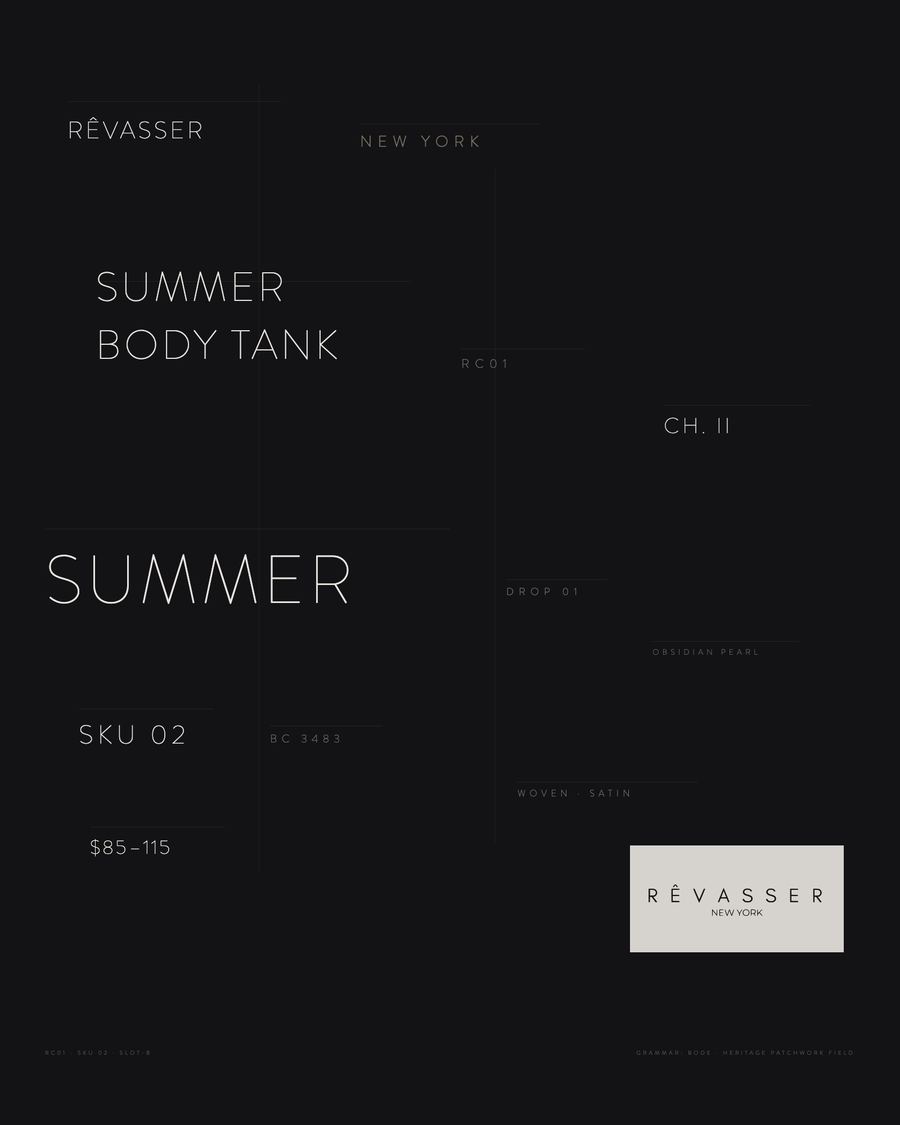
26 — SUMMER BODY TANK

COMMENTARY — James · 2026-04
COMMENTARY — BOARD 26 / SUMMER BODY TANK · SKU 02

SUMMER is a mood more than a mark. The tank is where spec has to catch up to the poetry.

TYPE-NERD READ

"SUMMER" set as a repeating vertical stack — stencil/slab register, all-caps, tight tracking (~0 to -10 units). Reads early-90s mil-surplus / varsity athletic.

Letterform weight medium-to-bold (~500-600), square terminals, geometric counters. Durable cut — holds up at small scale and reversed.

Vertical repetition is the hero move — SUMMER ×4 stacked creates a totem column. Eye reads it as texture + word simultaneously.

Baseline spacing between words is tight (~95-100% line-height) — creates the "column" effect. Opening to 110% would dissolve the totem.

Counters in S and M are generous — good for discharge print, won't fill in. R's leg is the weakest point; watch it at small scale.

DESIGNER READ

Very different register from RÊVER's whisper-thin elegance. This is blunt, American, athletic, sun-bleached. That's right — different drops need different emotional pitches, and Rêvasser should be able to hold both.

Inspires at totem-column scale — reads as graphic object, almost a concrete poem. The repetition is what makes it. Flattens if broken up into single words.

Tank garment + summer wordmark = correct pairing. Rib tank (2x1 rib, 200gsm combed cotton) in off-white or ecru grounds the print perfectly.

System note: would read stronger across the chapter if it picked up the MOS1 · DROP · SKU metadata language RÊVER uses. Consistent scaffolding across drops is how Rêvasser accrues recognition without relying on the wordmark.

PRODUCTION REALITY

This is DTF-ready. Stroke weight (~1.5mm at final size) is within safe print latitude. Counters are generous enough to avoid bleed.

Best methods in order: (1) water-based discharge screenprint, soft hand; (2) DTF matte; (3) flocking if you want a velvet texture nod to varsity.

Placement: front-center chest, 22cm tall × ~14cm wide. Or — more editorial — side-seam running vertically from ribcage to hem.

Ink color: break from pure black. Try sun-bleached navy (Pantone 5395) or terracotta (PMS 4835) on ecru ground to land the warmth.

Test wash before production: 5 wash cycles at 30°C, check for crack/fade. Discharge should survive cleanly; DTF watch for edge lift.

VERDICT

KEEP. Protect the monotony — that's the point.

The repetition is the concept; breaking it with color turns a concrete poem into a print gimmick. Push further through

composition, not chromatics

: (1) lock the mark pure — same tone, same weight, same tracking across the run. (2) Vary context instead — scale shifts (4", 8", 14"), placement shifts (chest, side-seam, back-yoke, hem), orientation shifts (vertical totem, horizontal band, baseline rotated 90°). (3) Add Rêvasser's spec-sheet metadata (MOS1 · DROP 02 · SKU 02) so the system registers across the chapter.

SLIDE 42
Slide 42

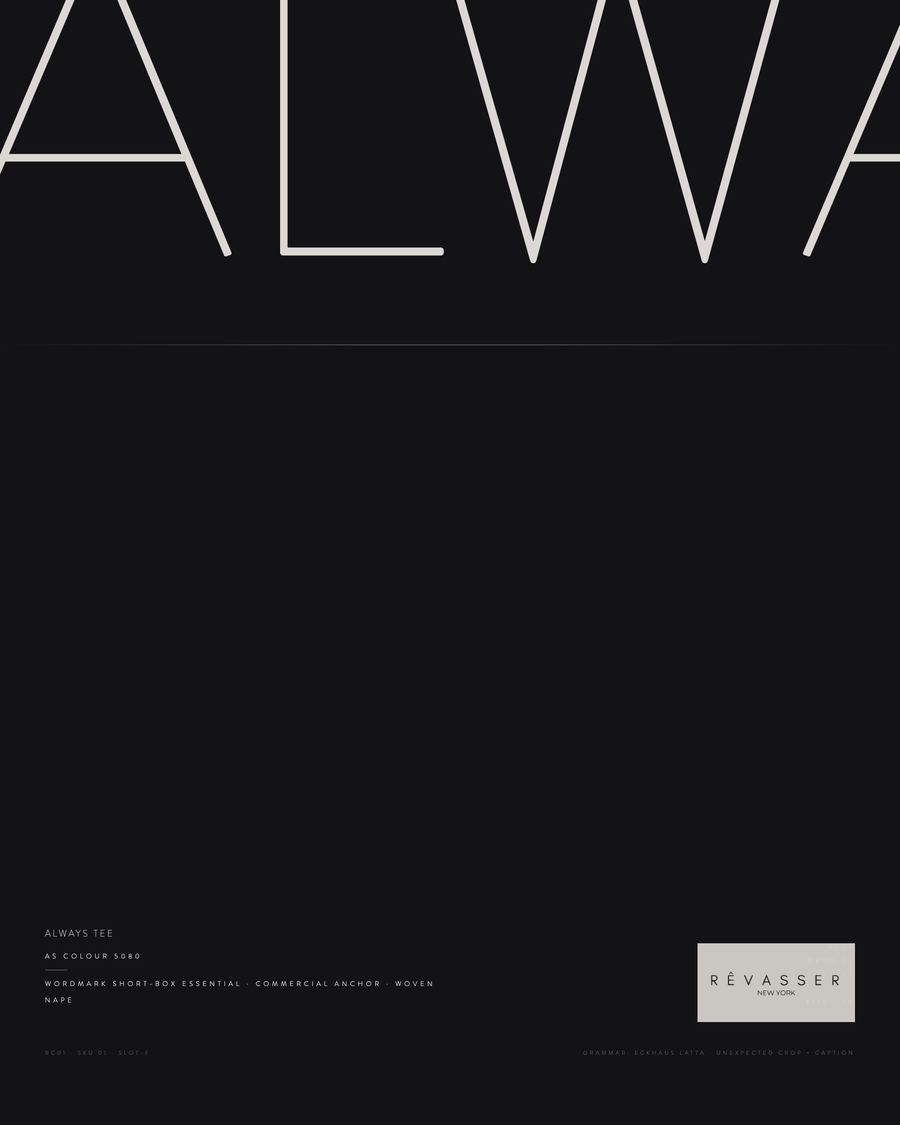
27 — DECONSTRUCTED × ALWAYS TEE

COMMENTARY — James · 2026-04

COMMENTARY — BOARD 27 / DECONSTRUCTED × ALWAYS TEE

Two wordmarks, one board. Where they complement, where they compete, and whether both earn the floor.

TYPE-NERD READ

DECONSTRUCTED is set in a distressed/eroded slab — chunky caps, broken counters, raw texture. Reads photocopied zine / punk /

deconstructivist

fashion (Galliano-era Margiela type registers).

ALWAYS TEE set in a cleaner spaced serif — mirrors the neck-tag RÊVASSER wordmark register. Quiet, considered, editorial.

Tension: the two faces don't share any DNA. One is eroded slab with blown-out contrast; other is geometric serif with ultra-fine strokes. Register clash.

If intentional (two product lines with distinct voices), the clash is defensible. If accidental, it's the board's biggest weakness — no typographic system.

DECONSTRUCTED's erosion is doing a lot. Read it three times: first as "ruined," then as "textured," then as "intentionally eroded." The third read is the good one.

DESIGNER READ

Pairing is ambitious — deconstructed/raw alongside always/essential. Philosophically sound: a brand needs both the rebellion and the reliable anchor.

Inspires in DECONSTRUCTED — the erosion has character, looks lived-in, hand-made. Best graphic on the whole board for pure emotional weight.

Reads flat in ALWAYS TEE at this scale — the serif is delicate, gets overwhelmed by DECONSTRUCTED's weight. Imbalanced hierarchy.

Two products on one board needs either a clear primary/secondary hierarchy OR equal weight with a shared system element.

Board-level success: the products tell a capsule story. Board-level failure: no shared typographic anchor pulling them into one family.

PRODUCTION REALITY

DECONSTRUCTED's eroded texture is print-method-sensitive. DTF handles it cleanly. Screenprint will lose the finest speckle (minimum dot ~0.3mm).

ALWAYS TEE serif: too delicate for DTF. Needs embroidery (silk thread, matte finish), foil transfer, or high-mesh fine-line screenprint.

Practical: two different print methods means two different production runs + QC. Doable but factor it into the cost/pricing model.

Placement: DECONSTRUCTED reads well at full-chest or oversized back print. ALWAYS TEE is a small-chest (heart pocket) or neckline graphic.

Different garment weights: DECONSTRUCTED on a 240gsm heavy oversized tee; ALWAYS TEE on a 180gsm mid-weight fitted tee.

VERDICT

SPLIT them — DECONSTRUCTED as hero, ALWAYS TEE as essentials anchor.

Three moves: (1) Don't show both on one board — each deserves its own slide. (2) Establish a shared system element — both get MOS1·DROP·SKU metadata. (3) Scale differently in marketing: DECONSTRUCTED goes hero/campaign, ALWAYS TEE goes catalog/basics. Don't compete them.

SLIDE 44
Slide 44

28 — TYPE STUDY (board 27)

COMMENTARY — James · 2026-04
COMMENTARY — BOARD 28 / DECONSTRUCTED · TYPE STUDY

At scale, the erosion stops being effect and starts being structure. What lands, what reads as affectation.

TYPE-NERD READ

Chunky slab caps, weight ~800-900 (Heavy/Black). Square terminals, uniform stroke width before erosion is layered on.

Erosion pattern: dry-brush or chalk-rub texture overlaid on solid letterforms. Not true distress — more like additive noise.

Counters in O, D, E, A, R stay fully open. Erosion doesn't collapse letter structure, just skins it. Important distinction.

Kerning is tight (~-20 to -30 units) — letters nearly touch. Locks the word as a single graphic block.

Stem contrast is zero — everything is heavy. No thins, no hairlines. Printable at any size.

Word length is the comp: nine wide characters, no horizontal breathing room. Column of letters, not string of letters.

DESIGNER READ

This is the best graphic move in the deck. Reads as punk-zine with luxury-object execution. Contradiction is the point.

Inspires at MASSIVE scale. If this is a sweatshirt back print, this is a campaign-hero-grade image. Can carry a whole collection.

The erosion texture stops being a trick and starts being material — like cracked leather, weathered paint, eroded stone. That's the good reading.

Fails if scaled small. At <6cm the erosion becomes JPEG compression artifact, not intentional texture. Never reproduce below 10cm tall.

Color: currently assumed black/white. Worth testing cream-on-brown, oxblood-on-cream, or charcoal-on-raw-cotton to land the archival / worn-in feel.

PRODUCTION REALITY

Erosion pattern is high-DPI detail. Must supply at 600dpi+ at final print size — 300dpi will smear the speckle.

DTF is the best print method. Matte finish only (glossy kills the texture read). Check ink temp and heat press — erosion edges are fragile to over-cure.

Screenprint backup: halftone conversion at 55 LPI minimum, water-based discharge on garment-dyed tees. Will lose ~15% of finest speckle.

DO NOT use flock, foil, or glitter. Kills the register entirely. Must be flat matte ink.

Placement options: (1) full-back print 35cm wide; (2) oversized chest 28cm wide; (3) small 8cm chest heart-pocket for a separate 'mini' SKU.

Garment: 240gsm heavyweight boxy crew, garment-dyed mushroom or washed-black for maximum thematic coherence.

VERDICT

HERO GRAPHIC. Push this to the front of the deck.

Three moves: (1) test at three scales (8cm / 18cm / 35cm) to find the size where the erosion lands correctly — my bet is 25cm+. (2) Test three color pairings beyond black/white: oxblood-on-cream, charcoal-on-washed-mushroom, cream-on-black. (3) Lock the size floor — never reproduce below 10cm tall; below that, swap for a clean version of the wordmark without erosion.

SLIDE 46
Slide 46

29 — TYPE STUDY (board 26)

COMMENTARY — James · 2026-04
COMMENTARY — BOARD 29 / SUMMER · TYPE STUDY

Repetition as composition. Where the totem lands, and where the rhythm breaks.

TYPE-NERD READ

Caps-only stencil/slab, weight medium-bold (~500-600), geometric construction — close to Trade Gothic Bold Condensed or similar cold-war workhorse sans.

Six letters: S-U-M-M-E-R. Even character widths, no problem characters. Prints clean at any size.

Vertical repetition stacks 4-5 instances. Line-height is tight (~92-95%), creating the column/totem effect.

Word-to-word spacing between stacked SUMMERs is slightly tighter than line-height — letters almost touch vertically. Creates pattern density.

No diacritics, no accents, no punctuation. Pure letterform grid. Easiest graphic to reproduce in the entire system.

If the stack is a pattern, the single SUMMER is a wordmark. Two registers from one asset — efficient.

DESIGNER READ

The repetition is what makes this work. SUMMER once is a word; SUMMER ×5 is a texture. The second register is the stronger one.

Inspires most in extreme vertical orientation — a column running the full side-seam of a tank, hem to armpit, ~50cm tall.

Reads slightly flat in the current monochrome. The totem wants either one chromatic break (one word in a different hue) or a subtle gradient (top word darker, fading to lighter at bottom).

Alternative compositions to test: (1) horizontal repetition across the chest — S U M M E R spread wide; (2) concentric / spiral arrangement on back yoke; (3) single large SUMMER at 30cm scale without repetition.

Typographic weakness: the M is structurally the heaviest letter — two M's adjacent create a visual dark patch mid-word. Watch the optical balance.

PRODUCTION REALITY

This is the most print-forgiving graphic in the whole system. All methods work: DTF, discharge screenprint, flocking, embroidery, heat-transfer vinyl.

Best execution: water-based discharge on ecru or natural tank. Soft-hand, vintage feel, no plastisol stiffness.

Alternative: puff-print for a tactile nod to 90s sportswear — each letter raises 2-3mm off the fabric.

Size range: reproduces cleanly from 4cm (woven label / hem tag) up to 50cm+ (full side-seam column). Very flexible.

Placement options: (1) front-chest totem 18cm tall; (2) full-side-seam column 45cm tall; (3) back-neck small stack 6cm tall; (4) repeat-pattern allover print at 3cm per instance.

Garment: ribbed 2x1 tank, 200gsm combed cotton — already spec'd. Consider adding a cropped muscle tee variant for a second silhouette at same SKU price.

VERDICT
PUSH THE TOTEM FURTHER.

The single SUMMER is fine; the stack is the real graphic. Three moves: (1) introduce one chromatic break in the stack — one SUMMER in terracotta or oxblood among cream siblings. (2) Trial side-seam placement as a secondary SKU — same tank, totem runs vertical hem-to-rib, not chest. (3) Explore the allover-print variant: repeat at 3cm scale as a textile pattern for a limited drop of shorts, bandana, or tote.

SLIDE 48
Slide 48

These are

svg

vectors too need to ascertain what to use for, or if at all

COMMENTARY — James · 2026-04
COMMENTARY — BOARD 36 / WORDMARK WEIGHT VARIANTS

Two weights, two different jobs. Pair them, don't pick one.

THE HAIRLINE (TOP)

Stroke/cap ratio ~0.06. Reads editorial, whispered, couture-adjacent. Circumflex floats — adds air rather than mass.

Built for:

interior labels, woven neck tape, lookbook headers, foil deboss on hangtags, web footer, signature at end of emails. Anything ≥18pt final size where the thin strokes can hold.

Don't use at:

<12pt final size (strokes vanish), on busy photography, or in any embroidery/chainstitch print method (thread can't hold hairlines).

THE MEDIUM (BOTTOM)

Stroke/cap ratio ~0.09. Still restrained but holds at smaller sizes and across more print methods. Spacing looks identical — same master, just weight variant.

Built for:

exterior hangtags, hem tape, screenprint on shopping bags, discharge print on tees (small scale, ≤80mm wide), business cards, lookbook spine, retail signage.

Don't use at:

billboard scale (gets bland), chest-hero graphic size (RÊVER serves that role better), or as a system default on every surface — it becomes wallpaper.

PAIR THEM — SYSTEM LOGIC

The two weights should live together in a hierarchy, not compete. Think of it like Lemaire's wordmark system: one cut for interior/hidden, one for exterior/visible. That's the logic here.

Add one more weight later (regular, ~0.075) and you have a three-level type system that covers every brand surface from packaging to print to digital without ever reaching for a third typeface.

Missing piece:

no lockup spec yet. Define min clearspace (~1 cap-height all sides), min width (50mm print / 160px web), approved colors (bone on slate, slate on bone only).

VERDICT

KEEP both.

Neither replaces the other — they serve different surfaces. Document the lockup rules now so freelancers and printers apply them consistently. Commission a regular weight (~0.075) to complete the system.

SLIDE 51
No visual · text-only
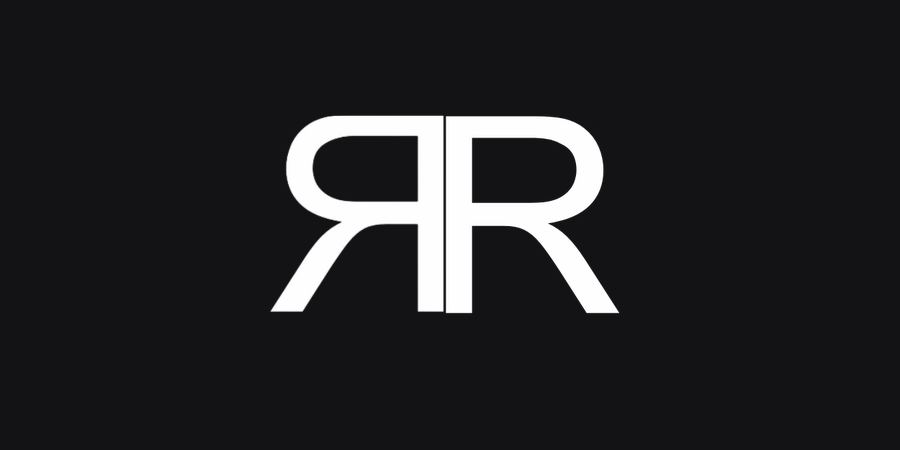
COMMENTARY — BOARD 37 / RR MONOGRAM SALVAGE BRIEF

The mark is salvageable. Not in its current bones — but the idea under it is sound.

DIAGNOSIS — THREE CONSTRUCTION ISSUES STACKING

1. Stroke weight — biggest offender

Stroke-to-cap-height ratio ≈ 0.17. That's Black/Heavy territory — Helvetica Black sits at 0.17, Didot poster cuts reach 0.20, Futura Extra Black ~0.19.

That weight class reads heraldic/automotive: Honda H (0.16), Bentley B (0.18), Chrysler pentastar (0.19). Editorial apparel marks live at 0.08–0.11: Chanel CC ~0.10, YSL Cassandre ~0.08, Vignelli AA ~0.08, Celine ~0.09.

Target:

0.09–0.10. On a 400pt cap height that's 36–40pt stroke — roughly half the current weight. This single move does 60% of the repositioning from "corporate badge" to "considered mark."

2. Closed crossbar — three compartments

The horizontal bar at mid-height creates three sealed negative spaces: two counters at the top bowls + one boxed compartment below. Marks that endure carry 1–2 negative shapes, never 3.

Reference: Chanel CC has 2 counters + 1 overlap void (still 3 but they're asymmetric and overlapping). YSL Cassandre has 1 unified void. Rolls-Royce RR has 2 mirrored voids — no crossbar. Our bar reads as a "strap" — vestigial, trying to tie the mark together instead of letting construction do it.

Fix:

Delete the bar entirely. Let the two bowls fuse at center and let the negative space run uninterrupted to baseline. Three compartments collapse into one unified channel. The mark breathes.

3. Splayed feet — decoration masquerading as structure

The diagonal flares at baseline carry no structural logic. They're a serif-adjacent flourish — reading as either varsity-collegiate (Princeton P, Yale Y) or automotive stance (Bentley's flared wing).

Options ranked: (a) vertical drops, sheared flat — most architectural, reads Swiss/Vignelli. (b) hairline-tapered terminals — softer, reads couture (Hermès H). (c) subtle convex curve — least recommended, still decorative.

Recommend (a):

Vertical drops align with the editorial register the wordmark and RÊVER are already setting. Protects the mirrored-R concept — the most valuable idea on the board — by removing the "badge" read entirely.

BRIEF FOR A TYPE DESIGNER — DELIVERABLES + GAP-TO-COMPLETE

Redraw at 0.10 stroke/cap ratio.

36pt stroke on 400pt cap. Build on a geometric grid (circle + square) — this is a constructed mark, not a drawn one. Add optical corrections at stroke junctions: -3% at the ligature crossing, +2% at the baseline terminals to prevent visual thinning.

Delete crossbar, fuse bowls, drop legs vertical.

Bowl-to-bowl ligature joins at 60% cap height. Central negative space descends uninterrupted to baseline. Stems terminate flat at baseline (no flare, no serif, no chamfer). Counter-to-stem ratio: 2.4:1 minimum to keep bowls from closing up optically at small scale.

Deliver three weights as a system.

Hairline (0.06), regular (0.085), medium (0.10) — matching the wordmark's two-weight system. Vector master + SVG + scaled raster (100/50/25mm). Minimum size spec: 12mm print, 40px web. Clearspace: 1 cap-height all sides. Approved colorways: bone on slate, slate on bone only — no other treatments until production tested.

VERDICT — SALVAGE.

4–6 hrs with a competent type designer (rate: $150–250/hr). Budget: $900–1,500. Do NOT deploy current cut on production until redrawn — this is the mark that will pair with the wordmark for years, don't let a Heavy-weight stopgap become house style by default.
SLIDE 52
Slide 52

There are transparent logo variations, but I'm uncertain whether they work reminds me of a business card or if the heaviness of the "R" and weight looks derivative or cheapens it.

The "R" seems to overwroght from the overall design.

COMMENTARY — James · 2026-04
COMMENTARY — BOARD 38 / MONOGRAM TREATMENTS

The outline version is diagnostic — it proves the problem is structural, not chromatic.

"Business card"

Tight negative space + heavy stroke + heraldic silhouette = corporate stationery register. Same visual family as law firm lockups (Cravath, Sullivan & Cromwell), financial services marks (JPM chevron), Ivy League badges.

Fashion houses avoid this silhouette because it signals institution/tradition rather than editorial sensibility. A brand betting on quiet luxury cannot wear a fraternal emblem.

"Heaviness of the R"

The R glyph itself carries asymmetric visual weight — bowl at top, leg at bottom-right. When mirrored, that asymmetry doubles: two bowls stacked + two legs extending. At 0.17 stroke ratio this reads as mass, not structure.

Critical: the "heaviness" survives the outline treatment because it lives in the glyph's skeleton — the R is the densest letter in the Latin alphabet by construction. A mirrored-R compounds the density. Only redrawing lifts it.

"Overwrought / cheapens it"

This is the signal. In luxury, restraint signals price confidence. The mark currently says "trying to look expensive." A refined cut says nothing — which is exactly what it should.

Compare: The Row's wordmark does nothing decorative. Loewe's anagram is geometric, not ornamental. Bottega Veneta removed its mark entirely for three years. The cheapening instinct is correct — this mark is over-designed for its context.

VERDICT — PARK ALL TREATMENTS.

Filled, outline, transparent — same mark underneath, same problem. Redraw first (see slide 39). Then re-test against this protocol. Your instinct on "cheapens it" is not subjective taste — it's reading real construction issues. Trust it.

WHAT YOUR GUT IS PICKING UP — UNPACKED

TESTING PROTOCOL FOR THE RE-CUT MARK

When the redraw is delivered, pressure-test it before approval:

(1) print at 12mm, 40mm, 120mm

— does it hold at all three, or does it break optically?

(2) place beside wordmark

— do the two stroke weights read as one system or two opinions?

(3) photograph on fabric

in DTF at 80mm, discharge at 40mm, foil at 15mm — which print methods the mark survives tells you its real register.

BROADER BRAND IMPLICATION

The brand system has three marks now: wordmark (hairline + medium), RÊVER drop graphic, RR monogram. That's one too many unless each has a clearly different job. If the monogram doesn't differentiate — same weight class as wordmark, same placement potential — it becomes redundant. The redraw isn't just aesthetic; it decides whether the monogram earns its place in the system at all.

SLIDE 58
No visual · text-only
CHAPTER — DESIGN SYNTHESIS · TECHNICAL RUBRIC

Typography system. The spine everything else defers to.

THE MASTER RULE

Every mark, letterform, and lockup sits within stroke/cap-height ratio

0.05–0.10

. This is the narrow range between Chanel CC (0.10) and YSL Cassandre (0.08). Anything outside this range breaks the deck's editorial register.

THREE-WEIGHT SYSTEM

HAIRLINE — stroke/cap ~0.06 (YSL register)

Use: interior woven neck tape, foil deboss on hangtags, lookbook spine, foil blocking on business cards, signage above 200mm. Minimum final size 18pt — below that, hairlines dropout on standard offset.

REGULAR — stroke/cap ~0.075 (commission)

Use: body text in lookbooks, site navigation, hem tags, hangtag sub-copy. Missing piece in the current system — commission this weight to bridge hairline and medium without discontinuity.

MEDIUM — stroke/cap ~0.09 (Chanel register)

Use: exterior hangtags, discharge screenprint on garments, retail shopper bags, campaign headlines at small reproduction sizes. Survives embroidery (minimum 2mm stem).

SPACING, PROPORTION, OPTICAL CORRECTIONS

Default tracking: +20 to +40 units at display sizes (above 24pt). Tightens to 0 at text sizes.

Editorial variant: +400 to +500 units for wide-tracked treatment (lookbook covers, seasonal banners, billboards). Single color only — never polychrome at this tracking.

Circumflex placement: optical alignment sits 4 to 6 percent above cap height, not mathematical center. The diacritic reads correctly when it appears to float, not attach.

Clearspace: 1 cap-height all sides. Min reproduction width: 50mm print, 160px web.

WHAT BREAKS THE SYSTEM

Any mark at stroke/cap > 0.12 — the RR monogram at 0.17 is the outlier and why it reads wrong

Polychrome saturated-per-letter treatments (Crayola register) — breaks the brand's tonal discipline

Any run-on type at minor weights — the deck is too restrained for overt display type

SLIDE 59
No visual · text-only

CHAPTER — DESIGN SYNTHESIS · PRINT CONTENDERS + ELEVATION BRIEFS

Six assets ranked by design merit. What to build. What each needs.

01 · TIER 1 HERO

Custom hairline wordmark

Stroke/cap ~0.06. Spaced display serif. Circumflex floats above optical center. Most ownable asset in deck.

Elevate:

commission regular 0.075 weight. Lock clearspace + min-size rules.

Lives at:

slide 1 neck tag. The deck's opening statement and its closing anchor.

02 · TIER 1 HERO

Skeletal three-stroke R

Stroke/cap ~0.05. Reductivist geometry — vertical stem, upper bowl curve, single diagonal leg. Scales 8pt to 2m without degradation. Vignelli-register.

Elevate:

formalize as vector master with 3% bowl optical compensation. Make the primary R-mark.

Lives at:

slide 14. Under-developed here — promote it to its own slide.

03 · TIER 1 HERO

Cosmos print family

Gouache, 6-petal cosmos geometry, hand-mixed pigment gradations. Three seasonal colorways: violet (SS), oxblood (FW), chartreuse (capsule). Same drawing, disciplined palette variations.

Elevate:

scan 600dpi, preserve petal-overlap transparency, soften to 88% opacity for DTF strikethrough safety.

Lives at:

slide 18. The most finished print asset in the deck.

04 · TIER 2 REWORK

R with botanical entwinement

Didone letterform with hand-rendered vines. Current execution is heavy — chunky vine weight, crowded leaf mass, stem too thick. Concept is strong; drawing is not.

Rework:

halve vine weight, reduce to 3 leaves, thin stem stroke, single-line vine topology not double-stroke. Retain Pantone 7427C.

Lives at:

slide 20 left. Returns as a secondary drop motif after redraw.

05 · TIER 2 REWORK

Wide-tracked wordmark (editorial)

Same hairline mark, tracking pushed to +400–500 units. Editorial-poster register. Current slide pairs it with rainbow color which cancels the editorial move.

Rework:

strip color, single-pigment black or bone-on-slate. Lock at 80–90% canvas width.

Lives at:

slide 26. Essential for lookbook covers + seasonal campaigns.

06 · TIER 2 REWORK

Rŷ reversed-R lockup

Mirror-axis construction, survives all tested palettes. 4-per-composition density optimal. Palette is oversampled in current board — 3 variants present when 1 default + 2 seasonal is enough.

Rework:

lock bottom-right earth+accent as default. Saturated-dark = seasonal. Pastel retired.

Lives at:

slide 22. Drop-graphic system across seasons.

SLIDE 60
No visual · text-only

CHAPTER — DESIGN SYNTHESIS · RETIRE, REWORK, NARRATIVE ARC

What the deck becomes once the noise is out of the way.

RETIRE — TECHNICAL REASONING

RR monogram (current cut) — structural fail

Stroke/cap 0.17 sits in heraldic/automotive range (Honda, Bentley). Horizontal crossbar creates three negative compartments where considered marks carry one or two. Splayed feet are serif-adjacent decoration. Park until redrawn per salvage brief — moves 1 through 3 documented on slide 39.

Polychrome wordmark (Crayola variant) — convention trap

Saturated-primary-per-letter carries 30 years of Apple, Google, eBay, children's-TV association. No re-framing can overcome the convention. Earth-tone variant survives only reduced to 2–3 colors.

Blurred/layered R — DTF incompatible

Gaussian blur fails the 300dpi hard-raster requirement. Fake motion cannot substitute for hand-material quality. Usable as 3–5s MP4 loop for digital only — never a garment.

Stacked gouache REVASSER lockups (L+R)

Redundant. Cosmos prints + R+botanical do hand-craft at markedly higher execution. Inconsistent letter weight + ambiguous R-reversal = craft level too low for brand register.

NARRATIVE ARC — DECK AS IT SHOULD READ

I · Foundation (slides 1, 36)

Custom hairline wordmark with circumflex. Two-weight system. Editorial-register spec language. The thesis statement.

II · Reference + direction (slides 3, 5)

Cropped menswear mood board validates the silhouette thesis. Hoodie direction sets premium-product bar.

III · Mark system (skeletal R, Rŷ, wide-track)

Three secondary marks sitting within the 0.05–0.10 stroke range. Each serves a different surface. Together they form a complete type system.

IV · Print library (cosmos + redrawn R+botanical)

Hand-painted register. Seasonal colorway discipline. Botanical accent for garment chest or back-yoke — small scale only, never chest-hero.

V · Worldbuilding (red room, ladder, studio)

Photography as brand signature. One set, shot across seasons. Ladder as recurring object. The spatial voice of the brand.

SLIDE 61
No visual · text-only
KEY
COMMENTARY — James · 2026-04

COMMENTARY — SLIDE 55 / BALENCIAGA PRIDE TANK · TECHNICAL ADAPTATION TO RÊVASSER

The garment blueprint is ideal. The graphic treatment is wrong for Rêvasser.

WHAT TO TAKE — GARMENT BLUEPRINT

2x1 ribbed cotton jersey, ~220gsm. Tight body fit with dropped armhole (~3cm below natural shoulder). Sits crop-adjacent — hem at iliac crest not waistline. Bound neckline in contrast rib, ~15mm binding width.

Side-seam vertical wordmark at ~8pt is a strong move. Armpit-to-waist placement = editorial-technical signal. Rêvasser-native: replace with hairline wordmark tracked +100 units in bone on black.

Waistband bind with repeating wordmark: 25mm elastic band, medium-weight wordmark in 9pt white on black, 70mm repeat spacing. This is an ownable signature surface.

WHAT TO LEAVE — GRAPHIC APPROACH

Pride flag grid on back = event-specific activism statement. Not a transferable design choice — the meaning is inseparable from the Pride 2022 moment.

Front bathroom-symbol graphic: universal-register icon, declarative. Rêvasser brand is quiet/editorial, not declarative. Don't port the pictographic strategy.

Small-point legal/disclaimer copy below graphic = corporate-PR register. Rêvasser spec-sheet language (MOS1·DROP 02·SKU type) does this work more elegantly.

RÊVASSER INTEGRATION PLAN

Front chest (center):

skeletal three-stroke R at 60–80mm tall, bone pigment DTF, centered on heart-pocket zone.

Side seam:

hairline wordmark vertical, 8pt, tracked +100 units, armpit to waistband, bone on black.

Back:

single cosmos bloom (FW oxblood) at nape position, 40mm tall; spec-sheet lockup below (MOS1·DROP·SKU), 9pt medium wordmark, 70mm wide.

Waistband bind:

25mm elastic, medium wordmark in 9pt white, 70mm repeat.

VERDICT

BLUEPRINT = KEY.

This is the right silhouette, fabric weight, construction, and surface strategy (front chest + side seam + back yoke + waistband) for a Rêvasser core tank SKU. Strip the declarative pictographic front and the activism backprint — port the skeletal R, hairline wordmark, spec-sheet language, and cosmos bloom into the four placement zones. 240gsm 2x1 rib, crop-adjacent fit, 3–4 size run.

SLIDE 63
No visual · text-only

KEY design to implement

COMMENTARY — James · 2026-04

COMMENTARY — SLIDE 56 / BALENCIAGA RACING-STRIPE CROP · TECHNICAL ADAPTATION TO RÊVASSER

The construction + racing-stripe logic is the move. The logo cut is not.

WHAT TO TAKE — RACING-STRIPE LOGIC

Twin parallel stripes shoulder-to-cuff on outer sleeve. Construction: ~15mm outer stripe + 8mm inner stripe separated by ~20mm gap. Reads cycling-kit / motorsport lineage — athletic-technical register.

Critically: stripes here use woven mesh tape sewn into a panel seam, not printed. Mesh creates sheer/contrast at the seam — slightly translucent at stripe, opaque at body. That is the move. Printed racing stripes read cheap; woven-in stripes read technical.

2x1 rib body, cropped at navel (~15cm above natural waistline), soft V-neck ~8cm depth, set-in sleeve with reinforced shoulder seam.

WHAT TO LEAVE — LOGO TREATMENT

Balenciaga B logo is Demna-era reversed-B monogram (stroke/cap ~0.18, heavy, decorative). Same weight class as the current RR monogram that failed. Don't mimic.

Wordmark underneath B: Helvetica Neue Bold all-caps. Corporate-athletic register. Rêvasser wordmark is custom and editorial — keep the surface but change the voice.

The logo + wordmark stacked at chest-center is a layout cliché of the 2020s. Rêvasser can hit the same surface with a single skeletal R and more restraint.

RÊVASSER INTEGRATION PLAN

Construction:

2x1 rib main body, 220gsm. Cropped at navel. Sleeve stripe as woven-in sheer mesh tape (not print). Stripe colors tonal: bone + slate (not bright white).

Chest:

skeletal three-stroke R at 25–30mm, bone DTF, single-mark — no stacked wordmark. Maximum restraint.

Stripe accent:

print hairline wordmark vertically inside the wider stripe at wrist cuff only, 6pt, tracked +200 — reads as hidden craft detail.

Waistband:

crop means no elastic bind — clean rolled hem, 12mm, stitched in contrast thread (bone on black).

VERDICT

CONSTRUCTION = KEY.

The woven-in sheer mesh racing stripe is the real technical move — it translates athletic-technical codes into editorial. Pair with the cropped rib body and you have a distinctive SKU that reads Rêvasser without imitating Balenciaga. Skeletal R at chest, hidden wordmark at cuff, rolled hem. Restraint is the competitive advantage.

SLIDE 66
No visual · text-only

COMMENTARY — SLIDE 59 / WHITE CROPPED TANK CASTING · REFERENCE READ

Confirms the silhouette thesis. Casting is the other half of the signal.

GARMENT READ

White ribbed cotton tank, cropped at navel, 2x1 or finer rib (close to 2x2). Bound neckline ~15mm. Fit is body-conscious but not compression — skims the torso rather than clinging.

No visible branding. That's the point. This is a core basic — it exists to be cast, photographed, styled, not to carry a graphic.

Spec: 180–200gsm ribbed cotton, natural or bone, not optical white. Optical white reads cheap at this silhouette.

CASTING IS HALF THE SIGNAL

Two models, natural posture, no styling beyond the tank + jewelry. Lean-athletic proportion, visible clavicle. Editorial register is created by casting decisions as much as by product design.

Background is bare — neutral wall, soft daylight, slight grain. Doesn't look studio-perfect; looks intentional-casual. That texture is the brand voice.

Jewelry choice: thin chains, layered, no statement pieces. Accessorizing stays hierarchically below the garment, not competing with it.

RÊVASSER INTEGRATION

Build this exact tank as the Rêvasser core basic. Bone-not-white 2x1 rib, 190gsm, crop at navel. SKU-01.

Branding: interior woven neck tape with hairline wordmark only. No front chest mark. No side-seam print. This is the garment that carries the brand through pure fabric quality and cut.

Shoot this SKU first. It sets the casting, lighting, and tonal palette that every subsequent product inherits.

VERDICT
THIS IS THE CORE SKU.

Build the unbranded cropped tank as SKU-01 and let it anchor the season. Pair with the Balenciaga Pride tank as SKU-02 (branded version of the same silhouette). Two tanks, one silhouette, two price tiers — basic and elevated.

SLIDE 67
No visual · text-only

Could sheer be purchased as a blank or this type of style? Also, what we would incorporate into it to make it more Rêvasser?

COMMENTARY — James · 2026-04

COMMENTARY — SLIDE 60 / SHEER BROWN TOP + LINEN PANTS · SHEER-BLANK QUESTION

Sheer is sourceable. The question is how Rêvasser occupies it.

Q1 — SHEER AS BLANK · REAL SOURCING

Yes, multiple tiers:

Blank Apparel / LA Apparel

sheer jersey L/S — $18–25/unit, no MOQ

Bella+Canvas 8881

sheer rib — $9–14, 12-pack MOQ

Alibaba / 1688 (Shaoxing mills)

80gsm cotton gauze — $4–8/unit at 300 MOQ

Portuguese mills (Riopele, Polopique)

— $22–40/unit at 500 MOQ, premium finish

Custom atelier (Naples, Mumbai)

— $45–80/unit cut-and-sew, 50 MOQ, couture finish

Reference fabric: ~80gsm cotton gauze. Alibaba tier is right for dev samples; Portugal for production.

Q2 — MAKING IT RÊVASSER

Garment-dye tonal:

buy white blanks, dye as single SKU to oxblood (Dharma Trading, Jacquard) — $3–6/unit labor + dye. Or contract dye-house: $8–15/unit for pigment-matched tonal.

French seams:

off-the-rack blanks come with overlock — adds $4–8/unit to retrofit to French seam construction. Better: spec French seams from cut-and-sew supplier at sourcing stage.

Rolled hem:

1.5cm narrow rolled hem at bottom + sleeves. Stitched on rolled-hem foot, ~$2–4/unit. Same technique Uniqlo uses on premium linen.

Not:

DTF. Backing film is visible through sheer. Only ton-sur-ton embroidery with water-soluble stabilizer works.

COST-STACKED UNIT ECONOMICS

MVP tier (Alibaba blank + NYC dye):

$6 blank + $5 dye + $3 hem + $4 embroidery + $5 label/tag + $2 packaging = ~$25 landed. Retail $95–125.

Production tier (Portugal cut-and-sew):

$40 all-in at 500 MOQ — dye + French seam + rolled hem + embroidery + label included. Retail $155–195.

Brand mark placement:

interior woven label tape (hairline wordmark, 7pt) + small side-seam tag (15×30mm, spec-sheet lockup) + optional embroidered R at chest, 20–25mm, matte tonal thread.

Pairing:

SKU-01 tank underneath (slide 60). Sheer over core basic reads considered.

VERDICT

BUILD IT — AS BLANK + GARMENT-DYE.

Source 80gsm cotton gauze blank, garment-dye tonal (start with oxblood for FW), French-seam construction, interior wordmark tape, optional tonal embroidered R at chest. Pairs naturally with SKU-01 tank underneath. DTF is not the technique here — keep it embroidery or nothing.

SLIDE 69
No visual · text-only

What could we incorporate here to make it more Rêvasser?

COMMENTARY — James · 2026-04

COMMENTARY — SLIDE 61 / RIBBED KNIT + HARP EMBROIDERY · INTEGRATION QUESTION

Knit is the right substrate. The harp is an ornament, not a strategy.

GARMENT READ — KNIT CONSTRUCTION

Heavy-gauge 12gg ribbed knit, ~320gsm, likely 70% merino / 30% cotton blend. Fitted body, set-in sleeve, ribbed stand or mock-neck collar. Natural/bone color, not bleached white.

Ribbed knit is the construction-led graphic — every vertical rib line is structural, not applied. The substrate alone carries editorial weight.

Chest emblem: ~80mm embroidered harp in green thread. Filled satin stitch, raised above fabric surface. Not suitable for mimicry — ornamentation is specific to the reference brand.

BLANK SOURCING — REAL OPTIONS

Alibaba Zhejiang knit mills

12gg merino blend blank — $18–32/unit at 300 MOQ

Portuguese knitters (Pinto Brasil, Lemar Malhas)

— $55–90/unit at 200 MOQ, factory finish

Scottish knitters (Johnstons of Elgin, Hawick)

— $120–220/unit at 100 MOQ, heritage-luxury finish

Italian knitters (Filpucci, Zegna Baruffa yarn + local factory)

— $140–250, editorial-luxury

Brooklyn knitter (Brooklyn Knits Co-op)

— $180–280, 20 MOQ, hyper-local NY story

Portugal is the sweet spot — premium finish at accessible price for a launch brand.

RÊVASSER KNIT SKU · SPEC + ECONOMICS

Fabric:

12gg rib, 70% merino / 30% cotton, 320gsm. Yarn: Zegna Baruffa or Biella merino for premium tier, generic NZ merino for Alibaba tier. Colors: bone, slate, oxblood, moss.

Construction:

mock-neck stand collar 4cm, set-in sleeve with reinforced shoulder, fitted body (not compression), hem ribbing 6cm at waist. Standard length.

Chest embroidery:

skeletal R at 40mm, Aurifil cotton 40 matte thread, tone-on-tone (bone on bone). Min 2mm stem width. ~$3.50/piece embroidery cost.

Unit cost (Portugal):

$70 blank + $3.50 embroidery + $6 labels/tags + $3 packaging = ~$82 landed at 200 MOQ. Retail $225–285.

Unit cost (Alibaba tier):

~$32 landed. Retail $115–145 — undercuts the premium positioning.

VERDICT

KNIT = YES. BORROWED SYMBOL = NO.

Build the heavy-gauge ribbed knit as an AW SKU with tonal-on-tonal matte embroidery. Use the skeletal R or cosmos bloom — never a symbol that doesn't already exist in your system. The technique is the transferable lesson; the ornament is not.

SLIDE 71
No visual · text-only

Could the geometric design be repurposed to something like this for Rêvasser? Alternatively, would it work for DTF print/blank or no?

COMMENTARY — James · 2026-04

COMMENTARY — SLIDE 62 / ASYMMETRIC TEE SEAMS · GEOMETRIC REPURPOSE + DTF

Seams as graphic. This is construction-led design, not print.

CONSTRUCTION-LED DESIGN

Asymmetric panel seaming creates the graphic — diagonal seam runs from left shoulder to right hip, cutting the body into two geometric panels. No applied graphic; the seam IS the mark.

Construction: flat-felled or lapped seam executed in contrast-color thread (~3mm stitch line width). Pattern-making cost is high — this is not DTF, this is pattern engineering.

Reads editorial-technical the same way the Balenciaga racing-stripe reads — construction creates the signal.

Q — GEOMETRIC DESIGN FOR DTF?

No.

The diagonal is a seam, not a graphic. Printing a fake seam on a tee reads cheap — it's the difference between wearing something made that way vs. printed to look that way.

DTF replicating seam work = counterfeit energy. The minute a customer runs a hand across the tee and feels no seam ridge, the illusion breaks.

This is one of the most common retail errors — borrowing construction-led silhouettes but executing in print. Do not.

RÊVASSER ADAPTATION

If you want this effect, commit to the seam. Build as a 2-panel tee with diagonal or vertical-offset seam from shoulder to hem. ~240gsm cotton, bone main panel, slate accent panel (tonal, not high-contrast).

Flat-felled seam in bone thread (matches lighter panel). 3mm stitch. Price point: $125–155. Higher than a plain DTF tee; much lower than a knit.

Interior neck label only. No chest print. Let the seam be the mark.

VERDICT

BUILD IT CONSTRUCTION-LED.

NEVER AS DTF.

Two-panel tee with real diagonal seam, tonal panels, flat-felled construction. The graphic is structural and that's what makes it worth $125+. Printing this would undermine every other product's craft argument.

SLIDE 73
No visual · text-only

Could the florals be elevated and designed to be repurposed to something like this for Rêvasser? Alternatively, would it work for DTF print/blank or no?

COMMENTARY — James · 2026-04

COMMENTARY — SLIDE 63 / MARNI JEANS + FLORAL PATCHES · FLORAL ELEVATION + DTF

Appliqué — not DTF. Rêvasser already owns the elevated botanical register.

WHAT THIS ACTUALLY IS

Marni appliqué patchwork. Multi-pigment floral motifs cut from contrast cotton/linen and sewn onto the jean — not printed, not DTF. Each floral is a separate sewn patch.

Construction cost: $80–150 per garment in appliqué labor alone. Executed at specialist ateliers (Naples, northern Portugal, or Indian textile studios). Not a fast-turn operation.

Reads hand-made, collected, textile-artist register. Marni owns this lane because Consuelo Castiglioni built it over 20 years.

Q — FLORALS VIA DTF?

No.

DTF on denim at multi-floral scale = craft fair, not luxury. The tactile difference between sewn fabric patches and a printed image is too large for this treatment.

You already have a more refined elevated-botanical asset — the cosmos print family (slide 18). It does quiet botanical at scale that sits right with the brand.

Competing with Marni at their own game is lose-lose. Either match their craft level (labor-expensive) or read derivative.

RÊVASSER BOTANICAL PATH

Primary:

cosmos bloom at 60–90mm hoodie chest accent or small hem tag. Single-motif discipline — not multi-floral scatter.

If scaling up:

jacquard-woven cosmos on shirt body or trouser pocket detail. Woven into the fabric, not applied on top.

If appliqué is wanted:

single large cosmos patch (100mm) tonal on back yoke of a denim jacket. One, not twelve.

Restraint rule:

your botanical is a whisper, not a statement. Never more than one per garment.

VERDICT

DON'T GO HERE.

Multi-floral appliqué is Marni's register — 20 years of brand equity in that lane. Rêvasser already owns quiet editorial botanical with the cosmos print family. Stay disciplined: one motif, one placement, one color per garment. Scale sophistication through restraint, not accumulation.

SLIDE 76
No visual · text-only

COMMENTARY — SLIDE 64 / WALES BONNER POLO + MARNI BLUR-SCRIPT · REFERENCE READ

Two different lessons in one frame. Polo is useful. Blur-script is not.

LEFT — WALES BONNER POLO

Cotton-silk blend knit polo, camp collar, chest patch with crest-style embroidery in single tonal thread. ~220gsm, fine gauge (14gg minimum).

What works: the camp collar, the knit substrate, the single tonal-embroidery chest emblem. All transferable to Rêvasser without imitation.

Rêvasser polo SKU: same construction, cosmos bloom or skeletal R at chest in matching tonal thread. 30mm emblem max.

RIGHT — MARNI BLUR-SCRIPT

Hand-painted or motion-smeared cursive wordmark on tee. Reads graffiti-tag, gestural, one-off. Marni deploys this as a seasonal art-direction moment, not a system.

Same problem as the blurred R on slide 21 — fake gesture reads cheap when flattened to print. The Marni version works because it's real paint on real cotton, not digital blur.

Don't import. Rêvasser wordmark is the custom hairline — its authority comes from precision, not gestural looseness.

RÊVASSER POLO BUILD

Fabric:

14gg cotton-silk blend (85/15), 220gsm. Colors: bone, slate, oxblood, moss.

Construction:

camp collar, 3-button placket in horn button, short sleeve, standard body length. Price point $175–215.

Chest emblem:

cosmos bloom 28mm in tonal matte thread (bone on bone, moss on moss, etc.). Or skeletal R 32mm same spec.

No print work anywhere. This garment leads with knit quality + tonal discipline.

VERDICT

POLO YES. BLUR-SCRIPT NO.

Wales Bonner polo is the template for a Rêvasser knit polo SKU. Marni blur-script is a counter-example — teaches restraint by showing the alternative. Rêvasser wordmark earns attention through precision, not gesture.

SLIDE 77
No visual · text-only

¯\

(

)

Could we

integrate a cheeky Rêvasser point here?

COMMENTARY — James · 2026-04

COMMENTARY — SLIDE 65 / EXPOSED-POCKET DECONSTRUCTION · CHEEKY RÊVASSER QUESTION

Inside-out pocket construction, not a slogan patch. This is deconstruction craft.

WHAT THIS ACTUALLY IS

Not a patch. The white panels are pocket bags turned INSIDE-OUT, exposed as a design feature. Raw-edge seam tape visible along sides. Construction is reversed — guts displayed as surface.

"S.T.F.U." is small-scale screenprint or stencil on the pocket bag canvas (~25mm). Positioned as if someone wrote on the inside of pants they never intended to be seen outside. The slogan is incidental — the construction is the statement.

Lineage: Margiela Artisanal (deconstructed/reconstructed), early Marc Jacobs, Vetements circa 2017, Kiko Kostadinov. High-concept deconstruction, not streetwear slogan.

I misread this first pass as a slogan patch. The actual move is pattern-engineering, not print.

THE TRANSFERABLE IDEA

The move isn't "slogan on garment." It's "private interior made public." That's a craft gesture, not a graphic one.

Rêvasser spec-sheet language already does this metaphorically — construction taxonomy (WOVEN NAPE · BOX ESSENTIAL) is normally interior-only vocabulary brought to the exterior label. Exposed pockets = the same idea applied to denim.

The Rêvasser wit lives in exposing the normally-hidden (spec-sheet terminology, custom wordmark on neck tag). This reference suggests extending that logic structurally.

RÊVASSER ADAPTATIONS

Denim SKU — exposed-pocket trouser:

12oz rigid denim, pockets cut from natural unbleached twill, turned out, raw-edge. Print the spec-sheet lockup (MOS1·DROP 01·TROUSER 001) on the exposed bag at 20mm, not a slogan. Price point $285–345.

Neck label evolution:

already exposes interior language on the exterior tag. This is the same philosophy at the labeling level. Keep iterating.

Avoid:

imported slogans (STFU, YAWN, etc.). The Rêvasser cheek is French-linguistic and spec-sheet-technical, not American-declarative.

VERDICT

TAKE THE CONSTRUCTION, LEAVE THE SLOGAN.

Exposed-pocket denim is a legitimate Rêvasser move — it extends the "interior made public" thesis you've already established with spec-sheet labels. Replace STFU with spec taxonomy (MOS1·DROP·TROUSER) at small print scale. Keep the deconstruction; refuse the declarative.

SLIDE 79
No visual · text-only

Embossing, or what technique?

COMMENTARY — James · 2026-04

COMMENTARY — SLIDE 66 / LUAR TONAL SATIN EMBROIDERY · TECHNIQUE QUESTION

Tonal satin embroidery on fleece. The right technique, the wrong category.

WHAT THIS ACTUALLY IS

Not embossing. Tonal satin-stitch embroidery on cotton fleece sweatshirt. Black thread on black ground. Script letterform ~180mm wide at chest center.

Technical spec: filled satin stitch (not outline), ~40wt polyester or rayon thread, 2-layer underlay for dimensional raise. Visible through shadow + sheen contrast against matte fleece body.

Reads "luxury sportswear" — tonal restraint via material contrast (matte fabric / glossy thread) rather than color contrast. Balenciaga B14 and Loewe cursive-L treatments use the same technique.

I mis-labeled as embossing first pass. Correct term: tonal satin-stitch embroidery, alternately "self-color" or "ton-sur-ton" embroidery.

COST + SOURCING

Digitization:

$80–150 one-time per design (convert vector to stitch file). Reusable forever.

Per-piece embroidery cost:

$4–12 for a 180mm wordmark at 30K+ stitches. Smaller marks (30–50mm cosmos bloom, skeletal R): $1.50–3.50.

Suppliers:

local (Brooklyn, LA) at 50-unit MOQ; Portugal/Turkey factories at 200-unit MOQ with 15–25% cost advantage; India ateliers at 500-unit MOQ for couture-grade finish.

Thread:

Madeira Classic 40 (rayon, glossy) or Isacord 40 (poly, durable). Match to hairline wordmark needs glossy; matte register needs Aurifil cotton 40.

RÊVASSER APPLICATIONS

Hoodie/sweatshirt chest:

hairline wordmark at 100–140mm, Madeira Classic 40 rayon for satin sheen, tone-on-tone (slate on slate, bone on bone). Heavy enough to have presence; restrained enough to survive the tonal discipline.

Polo chest:

skeletal R or cosmos bloom at 28–32mm, Aurifil cotton 40 for matte finish against fine-gauge knit. Lower stitch density (5000–8000) to keep the mark from puckering.

Sheer gauze (slide 61):

skeletal R at 20mm, water-soluble stabilizer (dissolves after stitching), minimal underlay. Only approach that works on gauze.

Knit (slide 63):

raised satin stitch on heavyweight rib, minimum 2mm stem width to survive knit structure without distortion.

VERDICT

TONAL SATIN EMBROIDERY = THE SIGNATURE TECHNIQUE.

Ton-sur-ton embroidery is the right primary brand technique for Rêvasser. Visible through material contrast (matte/glossy) not color contrast. Digitize the hairline wordmark and skeletal R once; deploy across hoodies, polos, knits, sheer gauze. ~$4–8/piece at production scale. This is the editorial-luxury technique, not DTF.

SLIDE 81
No visual · text-only

Good semi-crop boxy cut

COMMENTARY — James · 2026-04

COMMENTARY — SLIDE 67 / AVIATION COTTON CO. SEMI-CROP TEE · SILHOUETTE READ

Silhouette is right. Branding approach is a counter-example, not a model.

WHAT WORKS — SILHOUETTE

Semi-crop boxy cut is correct. Body width exceeds shoulder width by ~4cm (loose fit), hem sits at iliac crest not natural waist. Roughly 240gsm cotton, likely carded not combed.

Dropped shoulder seam, short boxy sleeves, wide ribbed neckline. Unisex silhouette — same pattern fits 5'6 to 6'2 with relaxed proportions.

This is the right tee pattern for Rêvasser unisex core — translates across gender markets, photographs well, ages well.

WHAT TO AVOID — BRANDING

Large front chest print "SEASON 10 · AVIATION COTTON CO." is loud streetwear — all-caps stacked lockup, high-contrast white on black. Typical of drop-culture brands (BLS, Palace-adjacent).

The declarative chest-hero approach would undercut the editorial-restraint register you've built. Works for streetwear where the audience wants to be a walking advertisement — not for adult editorial menswear.

Season/drop numbering is fine. Declaring it on the chest is not.

RÊVASSER UNISEX CORE TEE

Silhouette:

semi-crop boxy, dropped shoulder, wide ribbed neck, iliac crest hem. Exactly this cut.

Fabric:

240gsm combed organic cotton. Garment-dyed bone, slate, oxblood, moss. Price point $115–145.

Branding:

unbranded or tonal skeletal R at 25mm chest-center. Spec-sheet on interior woven neck label (MOS1·DROP 01·ALWAYS TEE). No season-name declarative print.

Drop naming:

keep MOS1/MOS2 seasonal tier language on labels, lookbook, site. Let drop numbering live in the spec, not on the chest.

VERDICT

SILHOUETTE YES, BRANDING NO.

Borrow the semi-crop boxy unisex cut and the 240gsm weight. Reject the declarative chest-hero approach. Rêvasser cut + unbranded or skeletal R chest + spec-sheet neck label = the editorial alternative to this streetwear register.